

 academiccompositionab
 Empowerment Equalizer
 SSaragian
 Antony Sammeroff
 Ann Sterzinger
 Rodney
 RJ
 busterjames
 cainusmaxus
 Craig FitzGerald
 David Heleniak
 Caity & Dan Greene
 keirmartland
 Keith Preston
 Bill the Butcher
 ljp711
 MRDA
 Jack Donovan
 Rachel Haywire
 comrade hermit
 Michael
 Vince
 Regan
 robertstark2014
 Noonan
 S E Pearson
 Rachel Haywire
 Nexus X Humectress

In my most recent edition of the #SolutionsWatch podcast on “Stopping the War Machine,” I soliloquized about the possibility of coordinated strikes disrupting the functioning of the military-industrial complex war machine.
To wit:
You and me and the people watching this, living at the bottom rung of the economic ladder, are the lifeblood of the economy. They depend on our support, our cooperation, our labour, our consumption, etc. We really are the deciding factor in whether they are able to continue this war machine functioning. All the other garbage they have built on top of this phony-baloney economy rests on our productive labour. And so, that really is our bargaining tool. It has been for a very long time.
Interestingly, recognition of that fact has been drummed out of us. When was the last time that you saw a serious, genuine, concerted attempt in the developed world to actually withhold or withdraw labour? When have you seen organized strikes for a specific purpose, like, “We are not going to fund this war on Iran! And, until that war stops: general strike!”
I know there were those in the audience to whom that sounded like pie-in-the-sky, wishful thinking. “Get real, James,” I heard you say. “No one’s ever going to go on strike to end a war. No one cares that much!”
Well, guess what? It’s haaaaaapppening! …
INTERNATIONAL DAY OF ACTION
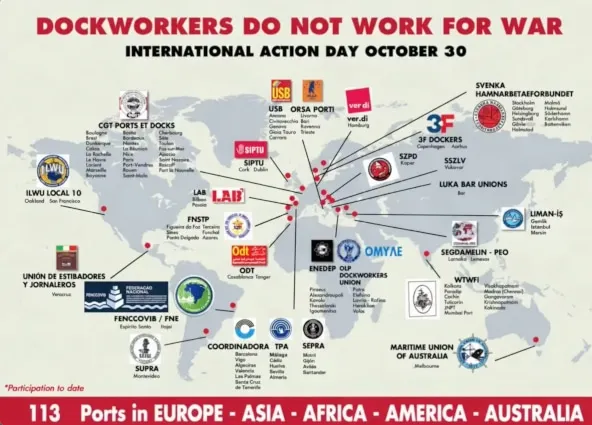
On October 30, dockworkers at 113 ports in 22 countries engaged in a coordinated strike under the banner “Dockworkers do not work for war!” Workers around the world joined the action to protest against the ongoing war in the Middle East and the subsequent militarization of ports in service of the war agenda.
The strike was originally organized by dockworkers in Italy, France, Greece, Spain’s Basque Country, Turkey and Morocco, and the call to action quickly spread around the globe. It even expanded to include strikes, protests and actions in solidarity by other labour organizations and activist groups, including the Unione Sindacale di Base in Italy, which called for a 24-hour general strike in Italy in sympathy with the dockworkers and their cause, and the Global Sumud Flotilla, a pro-Palestinian campaign group that is devoted to breaking Israel’s blockade on Gaza and that has vowed to “execute coordinated, strategic actions on the water” to support the dockworkers.
Countries with labour unions and dockworkers participating in the strike include:
CANADA

Last month, the Canadian Labour Congress (CLC)—Canada’s largest labour federation—voted in favour of a resolution calling on workers to “refuse to handle weapons and military equipment destined for Israel.”
According to the CLC’s official press release:
The CLC stands in solidarity with Palestinian workers and their families, and with all those calling for peace, justice and respect for international law.
Canada has a responsibility to ensure that weapons and military equipment produced here are not used to harm Palestinian civilians or contribute to violations of international humanitarian law.
We call on the Government of Canada to end all direct and indirect transfers of arms and military equipment to Israel.
The concern about Canadian support for the genocide in Gaza is not misplaced. A July 2025 report from Arms Embargo Now detailed “a continuous, massive pipeline of Canadian weapons flowing directly to Israel,” including “bullets, military equipment, weapons parts, aircraft components, and communication devices exported from Canada to Israel between October 2023 and June 2025.”
FRANCE

The Fédération Nationale des Ports et Docks C.G.T.—a major French trade union representing dockworkers, stevedores, and port employees—called a one-day strike at major ports around France to coincide with the day of action on October 30. The strike involved 7,500 dockers at 24 ports, including Dunkirk, Calais, Boulogne, Le Havre, Rouen, Paris, Cherbourg, Saint-Malo, Roscoff, Brest, Lorient, Nantes Saint-Nazaire, La Rochelle, Bordeaux, Bayonne, Port-Vendres, Sète, Marseille, Fos-sur-Mer, Toulon, Nice, Ajaccio, Bastia and La Réunion.
The federation joined the day of action in protest of what it calls “the militarization of port facilities” under European policies. The union’s general secretary, Tony Hautbois, promised French ports would be “95% shut down” as a result of the action, and subsequent reports confirmed that no trucks entered the port of Le Havre during the action and that “there is neither loading or unloading” of shipments there.
INDIA

India’s protest, led by the Forward Seamen’s Union of India (FSUI) and the Water Transport Workers Federation of India (WTWFI), involved about 5,000 dockworkers at major ports around the country, including Nhava Sheva, India’s largest container port, near Mumbai.
A representative from WTWFI in India noted the direct impact of the war between the US, Israel, and Iran on Indian water transport workers. So far, the war has resulted in the deaths of approximately 15 Indian crew members, and in many more crew being stranded at sea.
“The message going to the Indian government is that port and dock workers are not at war,” the representative told Indian outlet The Wire. “We are not going to export weaponized cargo. We will not do anything to further war. We want world peace. That is what we want to tell the Indian government.”
ITALY

The protests in Italy were massive, sweeping through 40 cities, including:
- a demonstration in Rome that ended in a march towards parliament that was dispersed by police using water cannons;
- a march in Milan that ended in front of the Politecnico di Milano university; and
- a demonstration of 15,000 port workers, students and activists who entered the port of Genoa.
The action enjoyed widespread support from the public in Italy, where cost-of-living demonstrations have been embroiling the nation in protests and marches for weeks.
Speaking to reporter Alex Colson, Unione Sindacale di Base member and port worker José Nivoi said, “Dockworkers want their hands dirty with grease, not with blood. So we have to block everything again.”
GREECE

The Greek dockworkers’ union call for a strike at Piraeus, the country’s largest port, coincided with a separate maritime worker strike over pay, working conditions and safety. The combined labour action resulted in the suspension of ferry services to the Greek islands and disrupted cargo operations at the busy port.
“We will not work for their wars, and we will not become food for their cannons,” Apostolos Kypraios, head of the Greek union of merchant marine engineers, told Reuters during a rally at the Greek port of Piraeus.
After gathering in Piraeus’ Municipal Theatre Square, the striking workers continued their demonstration with a massive march on Iroon Polytechniou Avenue.
AND ELSEWHERE…

And that’s not all. A report from World Cargo News highlights the truly international nature of this remarkable round-the-world labour strike:
In Germany, ver.di is participating at Hamburg, while unions in Denmark and Sweden are also supporting the mobilization. In Spain, participating ports include Valencia, Barcelona, Algeciras and Bilbao. Mersin is among the Turkish ports involved, while Tangier Med is participating in Morocco. India has support at about a dozen ports, including Nhava Sheva, Reuters reported. Support has also been reported from San Francisco and Oakland, Veracruz in Mexico and Melbourne in Australia.
If all this sounds like a big deal, it is. The action has been called “the largest coordinated port action of its kind,” and the groups that organized the strike estimated it cost the war machine tens of millions of dollars in economic damage.
They claimed that the action was impacting ports that collectively handle 13.5 percent of global shipping and 63 percent of container activity. They said the one-day delay would result in costs of $57 million, with $2.8 billion worth of cargo not moving. Organizers claimed in the Mediterranean alone they would disrupt more than 40 percent of cargo.
Now, if this were a one-time action by one specific group of workers on one specific day, never to be repeated, that would be one thing. But guess what? It’s not!
In fact, this coordinated day of action by the dockworkers is just one event in an unfolding campaign to derail, destabilize, disrupt and defund the war machine that grassroots activists have been running for over a year now.
The “No Harbour For Genocide“ (NHG) campaign is a grassroots activist movement organized by “a collective of researchers, organisers, activists and legal experts.” It is dedicated to “end[ing] maritime military and dual-use transfers” as part of a broader effort to “impose a comprehensive military embargo to end all military relations with Israel, including imports, exports, transfers, joint exercises and military cooperation, joint research and more.”
Their strategy relies on the recognition that the supply chains required by the war machine for their ongoing military campaigns are particularly vulnerable to disruption by coordinated labour action. Thus, the NHG campaigners relies on four key approaches:
- Supporting organization in key ports in the Mediterranean region that act as lifelines to the genocide fleet;
- Coordinating action across the key ports to sever the lifelines of support to this genocide fleet;
- Coordinating with dockworker and other transport and trade unions in these ports, and calling for port authorities and states to permanently refuse passage for these vessels.
- Targeting the relevant vessels’ operators/owners/charters/flags/insurers through legal, advocacy, media and BDS [boycott, divestment and sanction] approaches.
Given their success in this most recent strike, it seems their approach is working. But now the real question is whether other workers and everyday citizens around the world will commit to joining them in strikes, boycotts and other actions against the war machine.
THE BEGINNING OF THE BEGINNING?
The No Harbour for Genocide campaign is no doubt important, but there are other labour actions targeting the war machine, to be sure.
In 2024, United Auto Workers Local 4811, which represents the University of California workers, organized what was called the “most significant U.S. labor strike in the past two years.” Rallying around University of California graduate student Nate Edenhofer’s cry that “Everybody has some sort of vision of how they think the society we live in should be—most of them don’t think of it as being a genocide,” the union of 48,000 workers voted overwhelmingly for a resolution authorizing the executive board to call a strike. According to a statement from the union, “79% of participating members overall voted yes” on the resolution.
What resulted were months of “stand-up strikes”—strikes that roll from one workplace to the next to keep employers off guard—that grew to include the participation of non-union members, including additional faculty, lecturers and other university employees.
Here’s where the rubber meets the road. We’ve seen people standing up, willing to put their jobs and their livelihoods on the line to resist the war machine. But will others join them? Will we reach a critical mass of people who are willing to “put [their] bodies upon the gears and upon the wheels, upon the levers, upon all the apparatus” of this military monstrosity, as Mario Savio so memorably put it?
The answer to that question very much depends on whether people even know that any such coordinated protest movement exists.
As I said in my #SolutionsWatch podcast: when was the last time you heard about a coordinated international labour strike for any reason, let alone a strike specifically aimed at stopping the war machine? I can’t think of anything like this coordinated international day of action by the dockworkers taking place in recent history. And yet, if you hadn’t read this editorial, would you have even known this action had taken place?
If the answer to that question is “no,” then ask yourself this: why did you not hear about these strikes? Because they aren’t newsworthy? Or because the people who control the news desperately do not want you paying attention to these events or taking inspiration from them?
The question answers itself, if we’re being honest. The powers-that-shouldn’t-be do not want you to contemplate a coordinated, international action aimed at threatening the supply chains of their war machine. They do not want you to realize how vulnerable their military machinations are to such pressures. They certainly do not want you to participate in such actions yourself or to support those who are engaged in these strikes. And they absolutely do not want you to think about how you are or are not supporting the war machine with your labour or with your daily purchases.
What they do want if for you to internalize their own twisted propaganda that has been carefully crafted to convince you that resistance is futile. They want you to feel hopeless and defeated. They want you to look at this coordinated day of action and conclude that, since it didn’t end the war in a single day, it was a failure.
In other words, they want you to just shrug your shoulders and continue on with your lives, going to work and buying their products as usual.
Don’t believe their lies. Our attention, our intentions and our actions can and do make a difference. They wouldn’t be so desperate to cover up these remarkable developments if they didn’t have an effect.
Do you appreciate this type of essay? Then you’ll love The Corbett Report Subscriber newsletter, which contains my weekly editorial as well as recommended reading, viewing and listening.
If you’re a Corbett Report member, you can sign in to corbettreport.com and read the newsletter today.
Not a member yet? Sign up today to access the newsletter and support this work.
Are you already a member and don’t know how to sign in to the website? Contact me HERE and I’ll be happy to help you get logged in!

Recommend The Corbett Report to your readers
Attack the System

Categories: Uncategorized


