academiccompositionab
 Empowerment Equalizer
 SSaragian
 Antony Sammeroff
 Ann Sterzinger
 Rodney
 RJ
RJ busterjames
 cainusmaxus
 Craig FitzGerald
 David Heleniak
 Caity & Dan Greene
 keirmartland
 Keith Preston
 Bill the Butcher
 ljp711
 MRDA
MRDA Jack Donovan
 Rachel Haywire
 comrade hermit
 Michael
 Vince
Vince Regan
Regan robertstark2014
 Noonan
 S E Pearson
 Rachel Haywire
 Nexus X Humectress

by James Corbett
corbettreport.com
July 30, 2023
If you had met him as a boy, you might not have expected John Pierpont Morgan to amount to much.
He was a sickly child, for starters, constantly beset by rashes, headaches, rheumatism, scarlet fever and a panoply of other ailments. What’s more, growing up in the shadow of his powerful, domineering and wildly successful father, the self-conscious Pierpont (as he was called by friends and family) seemed weak and wilting by comparison. He showed little intellectual curiosity and was notably mercurial, often letting his hot temper get the better of him.
And yet, by the end of his life, Morgan would be hailed as a world-bestriding colossus of American finance, in turns venerated and hated and feared for the vast capital he controlled through his international banking network.
So, how did Pierpont’s life experiences shape that sickly young boy into the financial monarch he eventually became? And how did he, in turn, shape the world around him with the vast wealth that was at his disposal? Let’s find out.
THE HOUSE OF MORGAN
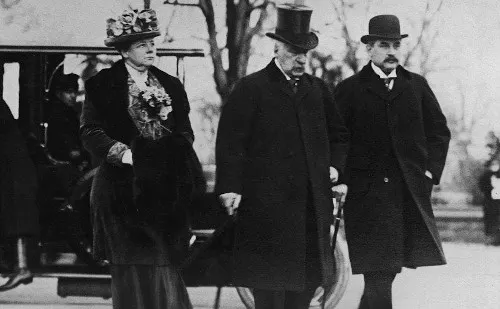
Every era has its kingmakers, its wheeler-dealers, its string-pullers, its financiers, and its master villains. Occasionally, one man embodies all of those roles at once. Such was the case at the dawn of the 20th century, when, if you had asked the man on the street to name America’s top kingmaker, its premiere wheeler-dealer, its strongest string-puller, its #1 financier or its master villain, you would have invariably received just one answer: John Pierpont Morgan.
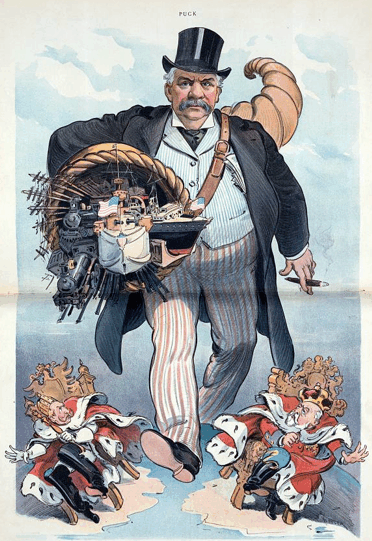
Dubbed “the Napoleon of Wall Street” by The Economist and “the boss of the United States” by muckraking journalist Lincoln Steffens, Morgan—with his corpulent physique, his walrus moustache, his cane and top hat and a grotesquely deformed nose that was painstakingly retouched for all official photographs and portraits—supplied editorial cartoonists with the iconic emblem of the Wall Street fat cat (emphasis on fat) for decades to come. In fact, we still recognize him as the symbol of Wall Street wealth to this very day; the artist who came up with “Rich Uncle Pennybags” (aka “The Monopoly Man”) for Parker Brothers used J. P. Morgan as his model.
But it wasn’t always obvious that Morgan was destined to become the world-famous caricature of wealth and greed.
John Pierpont Morgan was born in Hartford, Connecticut, in 1837 to Junius Spencer Morgan—a successful dry goods wholesaler—and Juliet Pierpont—daughter of John Pierpont, a fiery Unitarian preacher whose abolitionism and social activism eventually forced him out of the pulpit. It has been observed by his biographers that the very different temperaments found on either side of Morgan’s family tree account for the boy’s own ambivalent character, equal parts cold-hearted businessman and restless firebrand.
Attack the System

Categories: Economics/Class Relations