

 academiccompositionab
 Empowerment Equalizer
 SSaragian
 Antony Sammeroff
 Ann Sterzinger
 Rodney
 RJ
RJ busterjames
 cainusmaxus
 Craig FitzGerald
 David Heleniak
 Caity & Dan Greene
 keirmartland
 Keith Preston
 Bill the Butcher
 ljp711
 MRDA
MRDA Jack Donovan
 Rachel Haywire
 comrade hermit
 Michael
 Vince
Vince Regan
Regan robertstark2014
 Noonan
 S E Pearson
 Rachel Haywire
 Nexus X Humectress
A Model of Attritional Warfare Suggests Yes
The Persian Gulf war of USA/Israel against Iran has largely displaced reporting on the Ukraine-Russia conflict. Reading the news on mainstream media one may think that this war, now in its fifth year, is still in stalemate; or even that the tide is turning against Russia (Washington Post: Putin remark on war ‘coming to a close’ points to exhaustion, not peace, analysts say; NYT: I’m the Foreign Minister of Sweden. Don’t Overestimate Russia).
But quantitative models of attritional warfare say otherwise: Russia continues to dominate the battlefield and the eventual outcome, barring a Black Swan event, is inevitable defeat of Ukraine. My readers may know that three years ago I developed a an Attritional Warfare Model, AWM (based on the Lanchester equations) for forecasting this war’s outcome (see links at the end of this post).
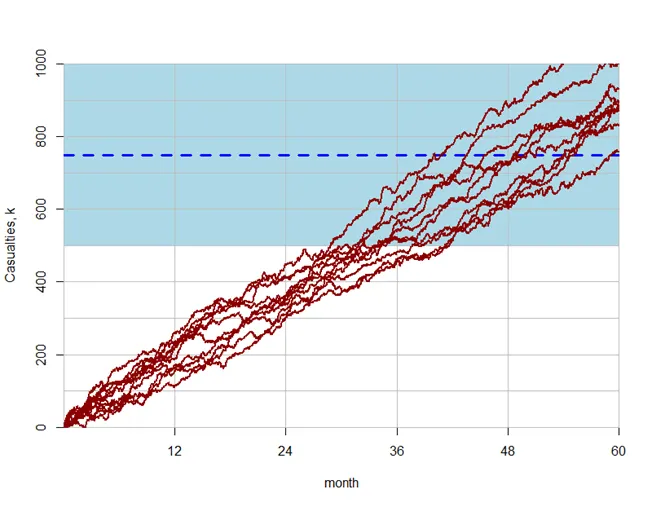
Ten realizations generated by the AWM for the dynamics of Ukrainian casualties. The blue band represents the estimated end point (the level of casualties when the war becomes unsustainable). Source
More recently a similar conclusion was reached by Warwick Powell (see Estimating Trajectories in Attritional Warfare: The Russia-Ukrainian Conflict Through a Quantitative Lens). Powell used a similar model, with the most important difference being the choice of the end point. My model assumes that the war ends when the level of casualties, as a percentage of population, exceeds a certain threshold, which I estimated via a sample of past attritional wars from the Correlates of War data (see the SocArxiv preprint below for details).
Powell, alternatively, assumes that the beginning of the end for Ukraine will happen when its army size declines below a certain threshold (0.65-0.73 of the initial size of 550,000). From that point, Ukrainian losses will accelerate and the full collapse will happen once the army size is below 50% of the prior peak. Powell’s model predicts that the tipping point will happen in July-September (updated on May 14).
Naturally, this is only a model-based forecast, not a prophesy. There is a lot of uncertainty about the estimates of various parameters. Furthermore, the threshold at which collapse occurs is only imprecisely estimated. For example, it’s not clear whether the threshold of 0.65-0.73 above which the Ukrainian force can maintain its operational integrity still applies on a battlefield heavily dominated by drones. For example, a smaller force size may be sufficient to continue defending positions given an abundant supply of drones.
My model also doesn’t incorporate any possible effects of the shift to the drone warfare — simply because it hadn’t happen when I published its predictions. Determining how this technological shift affects the AWM’s (Attritional Warfare Model) predictions will have to wait until the post-mortem after the war is over and when estimates would become much more precise. However, I tried a few preliminary explorations and they suggest that the drone effect on the war trajectory is not quite as huge as might be imagined. What’s important is the casualty rate inflicted on the Ukrainian army by the Russians, and it doesn’t matter whether it’s a result of artillery, air bombing, or drones.
Is Ukraine reaching its recruitment limit? This is the key factor in both our models. There are some indications that this is the case. A week ago, Branko Marcetic (using Ukrainian sources) provided some relevant numbers in a Responsible Statecraft article, Ukraine’s conscription crisis is getting increasingly bloody; While outside voices insist the war can still be won on the battlefield, young men in the country are violently resisting recruiters to stay out of it. Here are some numbers supporting this conclusion.
The number of complaints over possible violations committed by enlistment officers, received by Ukraine’s Human Rights Ombudsman, Dmytro Lubinets:
2022 — 18
2023 — 514
2024 — 3312
2025 — 6127
Source: Kyiv Independent
The number of violent attacks against enlistment officers shows the same trend: from 5 in 2022 to 117 in just the first four months of this year.
This resistance translates into lower enlistment numbers. Warwick estimates that (as of May 14) that on the Ukrainian side net daily loss rate is 900–1,700 units (as best as I can determine, by “net” he means the difference between casualty and recruitment rates). And in his estimation the current Ukrainian effective force has already declined to 320,000–380,000 (from the peak of 550,000). In other words, according to his calculations, the Ukrainian army has already entered the downward spiral.
When will these pressures reach the breaking point? Powell thinks by September of this year. But I would be much more cautious, because the nature of such dynamical processes resists precise predictions. Think of a steam engine with broken regulator valve. The pressure grows, but the timing of explosion cannot be predicted, because it depends on the presence or absence of internal flaws in the engine casing. Same with earthquakes: we understand perfectly the physics of them, but it can be years or even decades before they actually strike.
Ukraine is like a steam engine with internal pressures building up. But it is impossible to make an accurate forecast on when things blow up.
Here are the links to my blog posts on the Ukraine-Russia AWM:
What Osipov and Lanchester Tell Us about the War in Ukraine
War in Ukraine III: Projections
War in Ukraine VI: Adding Economic Power to the Attrition Model
War in Ukraine V: Alternative Hypotheses
The SocArxiv Preprint:
Empirically Testing Predictions of an Attrition Warfare Model for the War in Ukraine
You can experiment with the model here:
Attack the System

Categories: Uncategorized


