

 academiccompositionab
 Empowerment Equalizer
 SSaragian
 Antony Sammeroff
 Ann Sterzinger
 Rodney
 RJ
RJ busterjames
 cainusmaxus
 Craig FitzGerald
 David Heleniak
 Caity & Dan Greene
 keirmartland
 Keith Preston
 Bill the Butcher
 ljp711
 MRDA
MRDA Jack Donovan
 Rachel Haywire
 comrade hermit
 Michael
 Vince
Vince Regan
Regan robertstark2014
 Noonan
 S E Pearson
 Rachel Haywire
 Nexus X Humectress
War budget analysis. Greenland, Zaluzhny, the IMF.
It’s not easy being the avantgarde of western civilization. Which west?

Faced with an increasingly real conflict between a Europe that is enthusiastic to support Ukraine’s war effort, and a USA lacking such enthusiasm, Zelensky has made the obvious choice: Brussels over Washington. Along with this foreign policy alignment, Zelensky has rekindled suspended friendships with the top representatives of Ukraine’s euro-atlanticist elite: Zaluzhny, Prytula, Sternenko, Kubrakov, Kuleba, and Fedorov.
But given that the EU’s grand promises of aid constantly reveal themselves to be rhetorical mirages, just how long can Ukraine really last?
Numbers
Let’s start with the money, and then we’ll take a look at Kiev’s political signalling.
2026 is set to be Ukraine’s first year without US financial aid. In 2025, some residual Biden-era aid still came through. Now, it is solely on European largesse that Kiev counts, aside from whatever trickle of aid approved under Biden that still comes through.
After much-hyped negotiations aiming to gain assent for transferring seized Russian financial assets to Ukraine, the EU came to the much less exciting ‘solution’ of a 90 billion euro loan. Even then, many doubted this would be enough to sustain Ukraine for a year, let alone for the two years that Brussels claims the loan would suffice for.

Exactly how much does Ukraine need? Let’s first take a look at the evolution of the state budget, courtesy of the ministry of finances.
Spending as a percentage of GDP stayed relatively stable from 2008 to 2021, remaining at under 30%. The first year of ‘full-scale’ war, 2022, saw it rise to 52%, and in 2023 and 2024 it fluctuated around 60%. The budget deficit soared from under 5% of GDP to around 20% of GDP in 2022-24. This level is set to stay the same in 2026, but with much less western aid to cover it.
The data for 2025 budget spending and revenues isn’t yet fully available, with the figures for December still absent. Anyway, the original plan for the 2025 budget saw a budget deficit of 19% of GDP, slightly below the 2024 figure. All of that was to be covered by foreign funding: 32 billion euros.
The 2026 budget was finally accepted in early December 2025. Revenues will rise to ~57 billion euros, a 15% increase compared to 2025, and expenditure will reach ~95 billion euros, a rise of 3%. That’s a budget deficit of around 41 billion euros, 18.5% of GDP. As usual, almost all of this is to come from foreign donors. But this time, they are much less guaranteed.
The ministry of finances states that only 60% of expenditure will come from Ukrainian tax revenue. And almost all of that will be spent on the army, covering all military spending (27% of GDP).
So, at least theoretically, even if Ukraine can’t find enough foreign aid, it will still have enough for the army. But that’s only theoretically.
Anyway, the MoF hence predicts that 41 billion euros in external financing will be necessary, but it doesn’t know where they will come from. The US is not seen as a possible source of foreign aid:
Resources are expected to be attracted from the World Bank, the EU, the United Kingdom, the IMF and the G7 countries.
Perhaps I’m missing something, but I haven’t been able to understand why exactly the Ukrainian minister of finances stated in October that Ukraine would require 51 billion euros of foreign aid in 2026-7. I suppose the December budget was simply over-optimistic? This significant dissonance between the minister of finance and the ministry of finance is quite something.
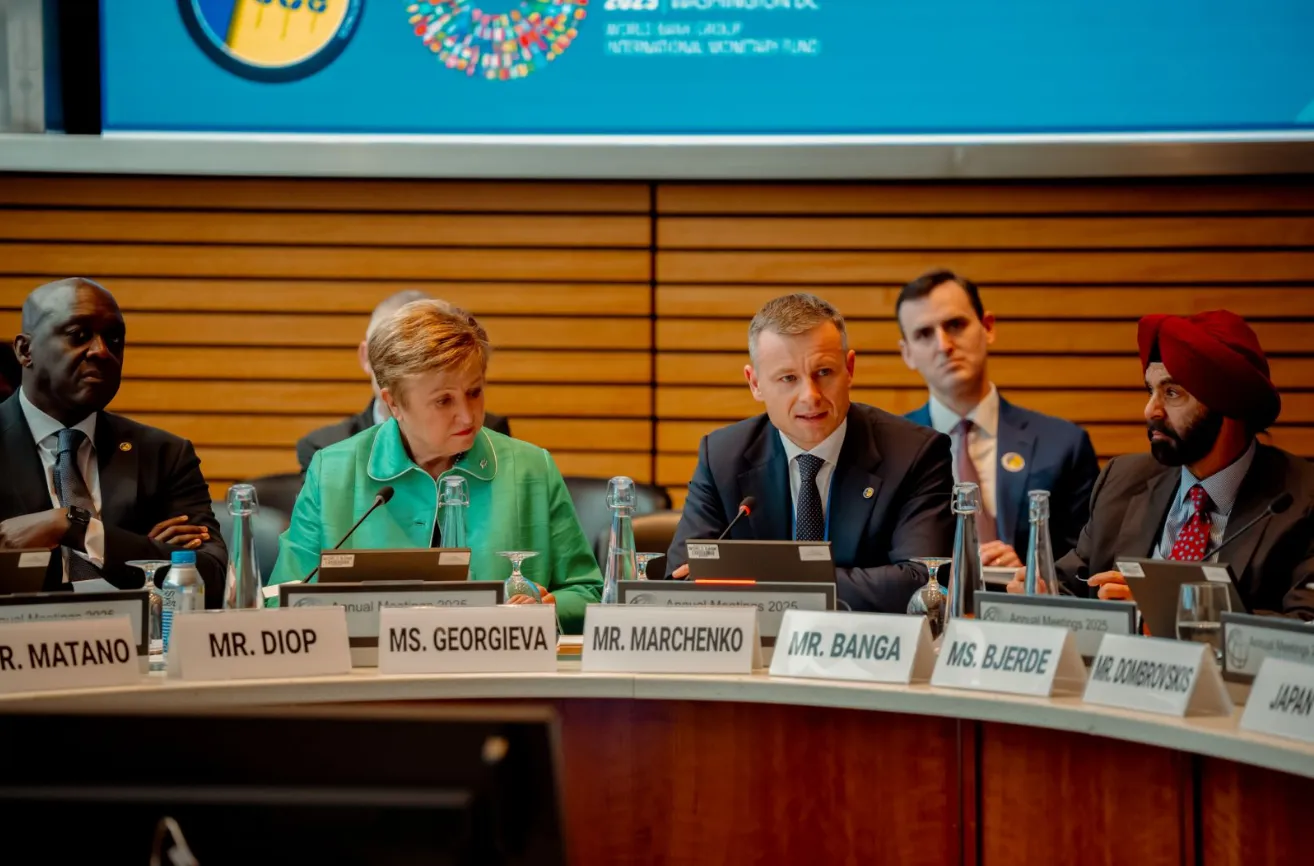
For its part, the IMF also estimates a higher 2026-27 financing gap: $54 billion euros. And that depends on highly optimistic prediction of 4.5% GDP growth in 2026, which is greater than market estimates.
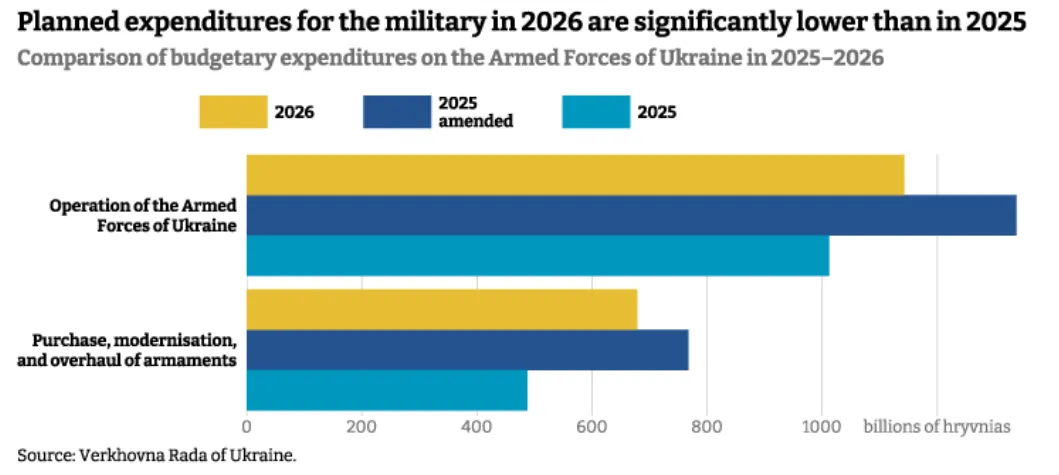
Others agree that Ukraine’s external financing needs will be even higher than planned. EU publications like the Centre for Eastern Studies (CES) predict that the 2026 budget will outstrip planned spending. The CES points to the fact that while non-military expenditure like healthcare and education are to rise significantly (which many in Ukraine believe is Zelensky’s attempt to gain popularity domestically), spending on the ministry of defence is meant to fall significantly compared to 2025. In 2025, planned military spending had to be amended upwards three times.
There are even higher estimates out there. For instance, Bohdan Popov, a political adviser at United Ukraine, predicts external funding requirements ‘in the range of €70-80 billion annually’. That’s assuming that the war continues over the course of 2026 and 2027. A fairly good bet, if you ask me.
Funding sources
So anyway, to recapitulate, the 2026 budget claims that Ukraine needs 40 billion euros in foreign aid in 2026, the minister of finances has said that 51 billion is necessary, and the IMF predicts 54 billion will be needed. Some even talk about 80 billion euros.
In short, it’s clear that the budget is overoptimistic.
The last IMF loan was proposed in November 2025. However, it keeps on getting delayed. What kind of world is it where a poor eastern European country can’t even count on the IMF?
Originally meant to be finalized in January 2026, the deadline for finalizing hte loan was once again postponed on January 19. And truth be told, the amount of funds at stake isn’t that impressive either:
The IMF Board of Directors might approve a new four-year Extended Fund Facility (EFF) for Ukraine worth $8.1B/€6.9B in February, but this will mainly depend on Ukraine’s implementation of actions that have been previously agreed upon, said Julie Kozack, the IMF’s Director of Communications, after a visit to Kyiv by IMF Managing Director Kristalina Georgieva.
Kozack added that Ukraine has so far met only one condition for the IMF program – the adoption of the 2026 state budget. Other conditions include expanding the tax base by passing legislation on taxing income received through digital platforms, closing customs loopholes for consumer goods, and removing VAT exemptions.
Georgieva emphasized that resolving the issue of the introduction of VAT for individual entrepreneurs (FOP) in Ukraine is essential. She said the IMF will only require that this decision be submitted to parliament, and the IMF is considering giving Ukraine a year to secure parliamentary support for this law’s passage.
These tax raises on small and medium business are extremely unpopular in Ukraine, leading to fairly large protests supported by nationalists in 2020 and 2021. Yuliya Tymoshenko constantly railed against these and other IMF conditions, with her votes playing a major role in preventing them. Now she is being threatened with up to 10 years in jail by the IMF-aligned anti-corruption organs. Coincidence?
Anyway, the IMF does have something to be proud of. No doubt the IMF is glad that 3.9 billion euros of 2026 revenues are set to come from the privatization of state property. The IMF can also be pleased that over 10 billion euros will be spent on servicing external debt – the second largest form of expenditure after military spending.
‘There’s no money, but you hold on’, to cite the immortal words of Dmitry Medvedev.
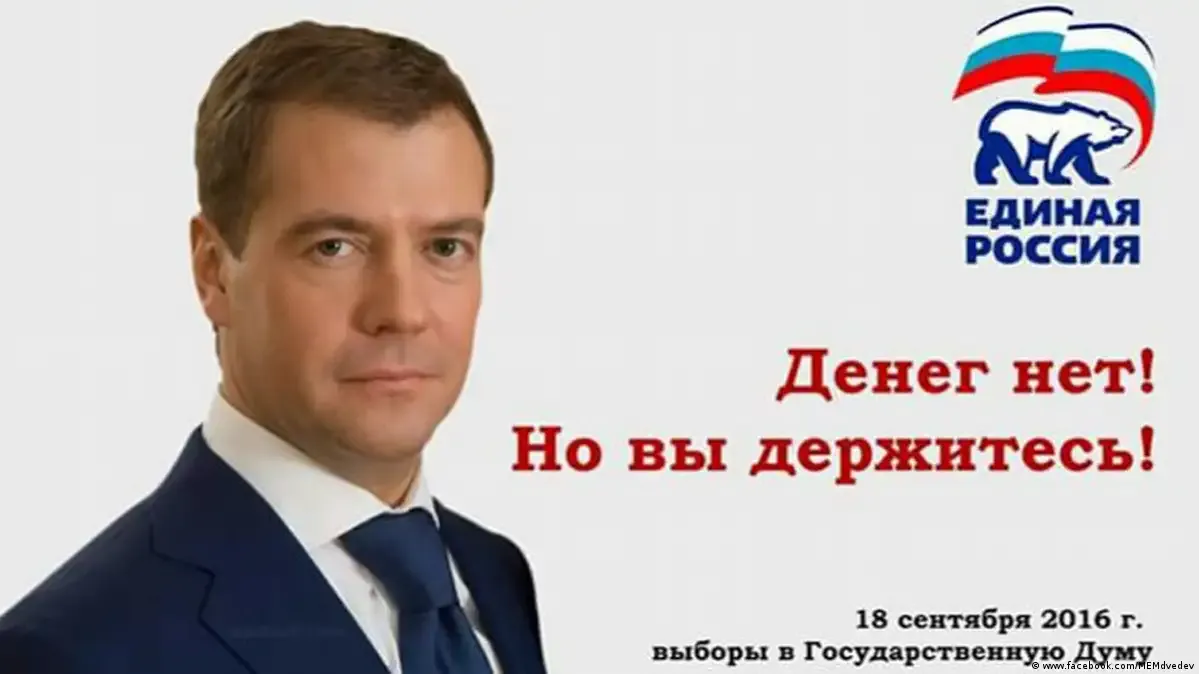
Though Medvedev is no longer very well-inclined towards Ukraine, Kyiv has new friends. The Managing Director of the IMF, Kristalina Georgieva, came out with some helpful advice to Ukraine on January 20:
Electricity, heating are still subsidized… We know why the country does this, but we need to get rid of it.
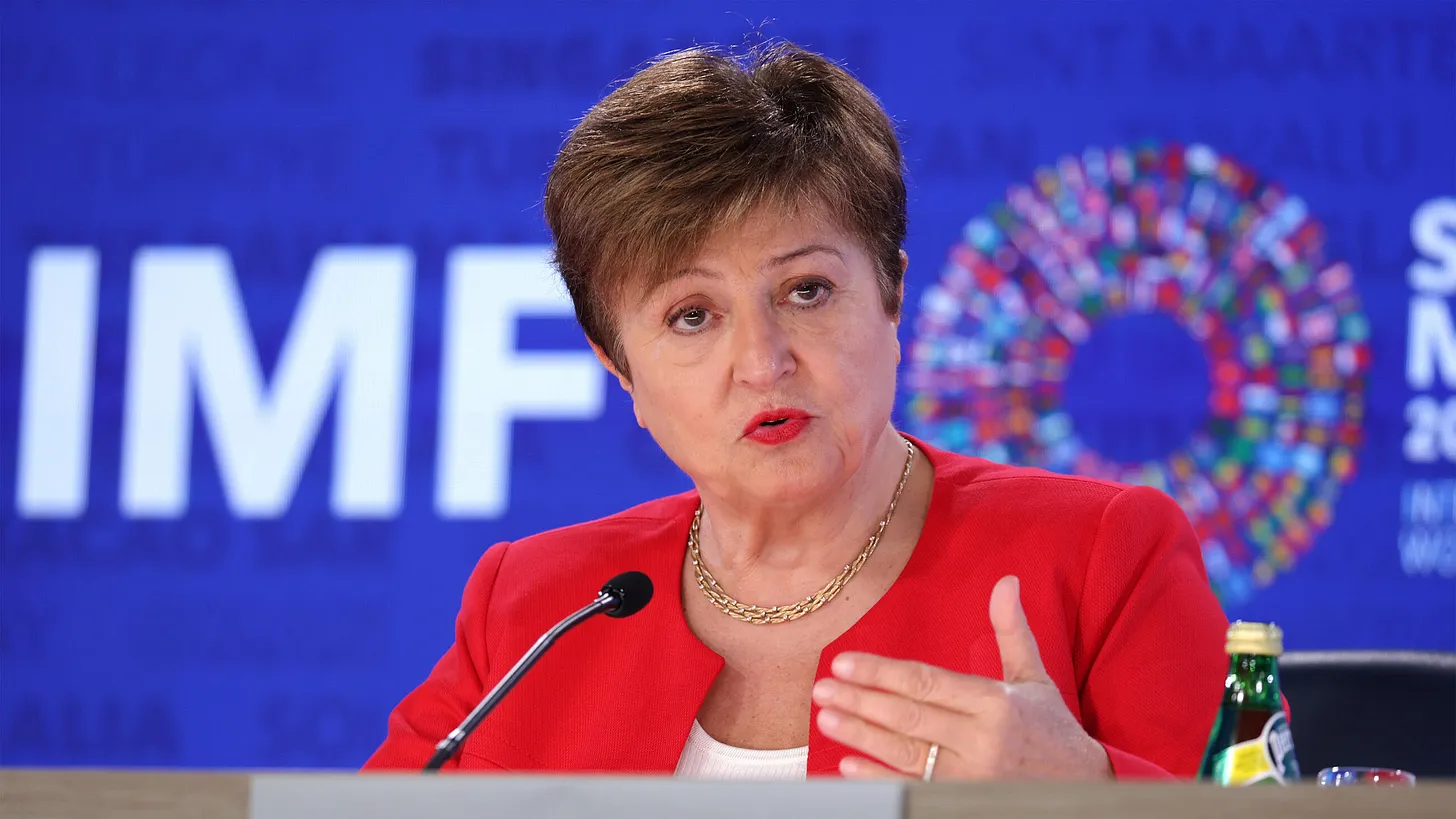
Naturally, she also urged to liberalize all obstacles to the availability of labour, so as to best guarantee the ‘dynamism’ of private capital.
She doesn’t seem to be worried about how Ukrainians, freezing in the millions due to Russian strikes on energy infrastructure, will feel about that. Anyway, it isn’t like their opinion matters much. For those finding it difficult, Georgieva has the following excellent advice:
Thirdly, you must believe in yourself like a lion. So get up in the morning and roar. Confidence matters. And I tell you from my own experience, the Bulgarian experience, that it will not be easy. But if you have this confidence and demonstrate it day after day, if you put aside internal disputes, if you bury corruption forever, of course you will succeed
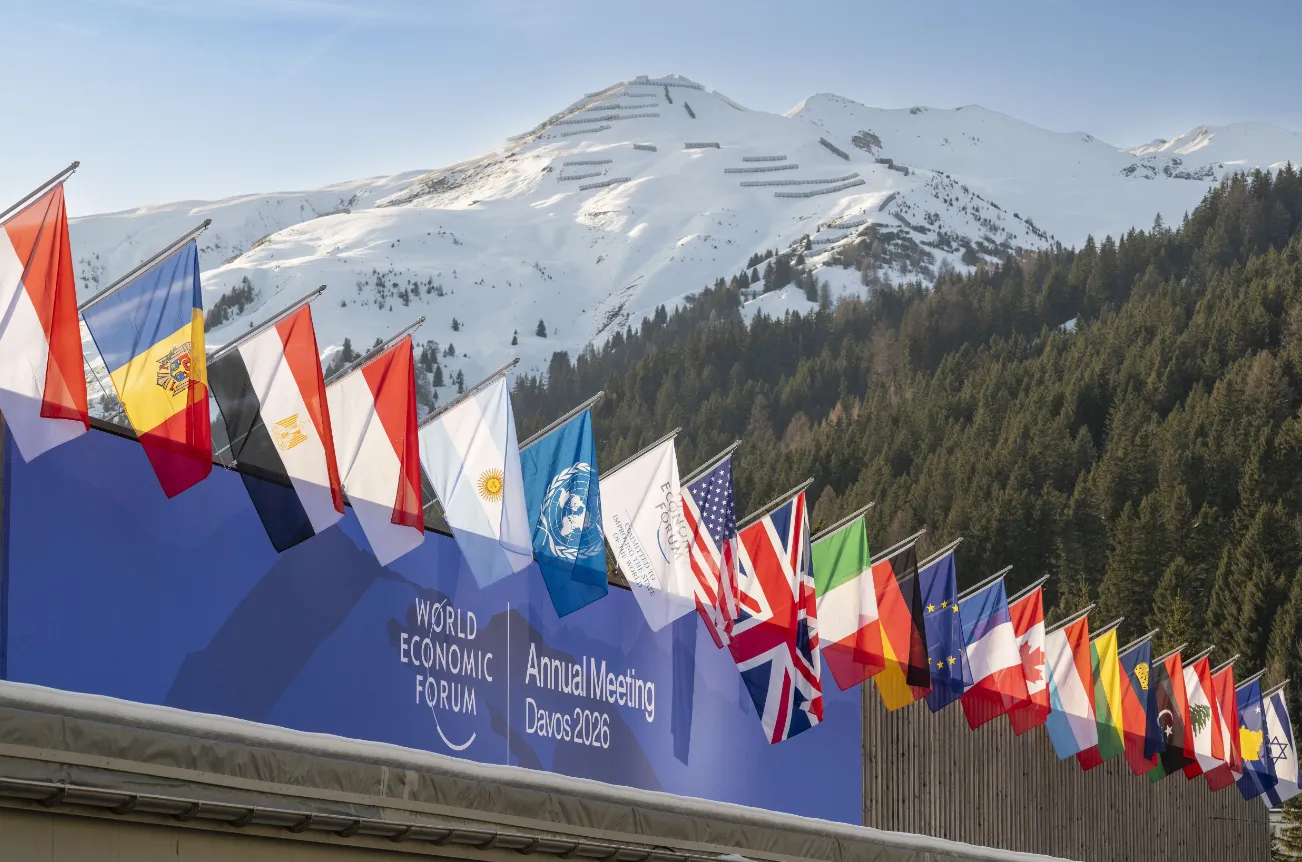
She stated this, of course, at Davos. More specifically, the project “Ukraine: On the Front Lines of the Future” organized by the Victor Pinchuk Foundation on the sidelines of the World Economic Forum. Pinchuk, is a Ukrainian oligarch I’ve written about at length, who cosplays as a Ukrainian Soros while himself having a much more ambiguous relationship vis a vis the west.

Like the IMF, the Europeans also aren’t rushing to translate their words of support into action. Last week, the EU revealed an important detail about its 90 billion euro loan:
The proposed support would be structured in two components, with approximately two thirds, amounting to €60 billion, allocated to military assistance, and the remaining one third, corresponding to €30 billion, provided as general budget support.
In the same statement, the EU writes that it has provided 193 billion euros to Ukraine since 2022. The bulk of of that aid went to supporting the Ukrainian budget, with a small remaining amount of humanitarian aid. That amounts, on average, to about 48 billion euros in total aid per year.
The US, by comparison, sent $128 billion USD from 2022 to 2025. 53 billion went to direct budget support, and the rest to weapons purchases. To put it in euros for the sake of consistency, that’s about 109 billion euros in total aid. That amounts to around 27 billion euros a year.
Now, the new EU loan involves 45 million euros a year in total aid. But two-thirds of it will go towards military assistance, which largely means buying US weapons at a 10% markup as part of Donny Deals’ PURL arrangement. This leaves only 15 billion euros a year in actual budget aid.
But the Ukrainian budget requires 40-80 billion euros in external financing for the 2026 financial year alone!
So what will happen? Maybe social spending will be cut, though that will look quite funny given that it was Zelensky who originally decided to raise it for the 2026 budget, despite criticism from nationalists (and the west).
I doubt that the front will collapse if Ukraine doesn’t get enough money to cover its deficit. After all, domestic revenue supposedly accounts for all military spending, in the planned budget at least. But as we saw, many western experts predict Ukraine’s actual military spending to increase significantly beyond what was planned. And so, these budget constraints will certainly have at least some effect.
In short, the coming years certainly won’t see any increase in Ukrainian military capacities. More of the same, in other words. The Ukrainian public seems capable of accepting seemingly endless deprivation, without any actual organized resistance to the state. In any case, the government probably has good reason to believe that.
The increase in social spending was likely less an attempt to stave off a popular rebellion and more-so preparation for possible elections. These elections seem increasingly unlikely, given that Zelensky only began considering the option because of Trump’s prodding. But now Kiev seems to be breaking with Washington. Hence, no need to prepare for elections, and no need to placate the populace. Perhaps the IMF need not worry so much about Ukraine’s profligate social spending.
Davos down
Anyway, enough of those numbers. Time for some good old-fashioned political intrigues.
Zelensky was meant to attend Davos and meet with his good friend Mr Trump this week. However, he didn’t make it. In a statement on January 20, the Ukrainian president claimed that he had to stay in Ukraine to deal with the effects of Russia’s strikes on energy infrastructure. In the past, of course, he hasn’t let the suffering of Ukrainians stop him from foreign trips.
Zelensky made it quite clear why he didn’t go, in fact. On December 20, he told the Ukrainian media that the USA ‘hasn’t been able to stop Putin’. This was his answer to a question about how he rates Trump’s attempts to end the war. Of course, Zelensky made sure to state that he is ‘grateful to the US for their aid’. He also tried to remain positive about the new denizen of the White House:
President Trump restored intelligence sharing, we have Patriot missiles. Not everything is perfect – but it’s coming
In that same interview, he also spoke out in favour of poor little Denmark, stating his support of its territorial integrity and sovereignty vis a vis Greenland. He said that he hoped the US will “listen to Europe in the format of diplomacy” and that there will be “no major threats” in this matter.
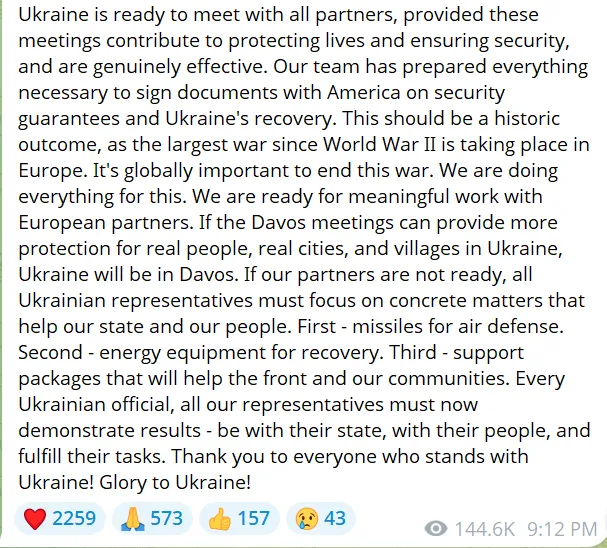
Zelensky also made his frustration with the US somewhat evident in the following January 20 post:
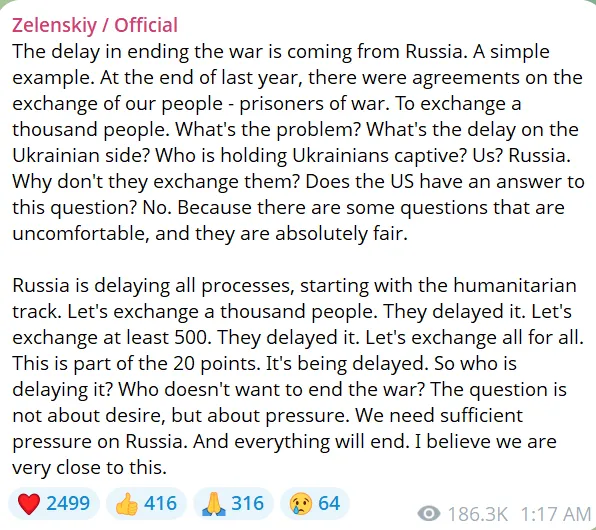
Keep in mind Trump’s December 15 statement that it is Zelensky, not Putin, that is preventing peace talks from succeeding. Zelensky seemed to have a fairly frustrated riposte to that on the 17th:
Zelensky’s diplomatic team has also been in the US since the 17th, but there have been no major statements about the progress of the talks. Generally, such trips are accompanied with plenty of grandiose statements about the massive successes of Ukrainian diplomacy. The relative silence speaks volumes.
New old friends
Back home, Zelensky has also decided to renew some of his most fractious friendships — with the country’s top euro-atlanticists. Or, to use the term not unjustly used in Ukraine, the Sorosites.
Over the past week, Zelensky has rammed through a truly powerful social media blitz. He met with no less than six top Sorosites. Just about all of them were fired or otherwise persecuted by Zelensky over the past few years, but with the malovolent Yermak (supposedly) gone, it’s time to get back together. After they forced Zelensky to get rid of his beloved chief of staff Yermak in late 2025, he has become more dependent than ever on these ultra-militaristic forces.
Attack the System

Categories: Uncategorized


