

 academiccompositionab
 Empowerment Equalizer
 SSaragian
 Antony Sammeroff
 Ann Sterzinger
 Rodney
 RJ
RJ busterjames
 cainusmaxus
 Craig FitzGerald
 David Heleniak
 Caity & Dan Greene
 keirmartland
 Keith Preston
 Bill the Butcher
 ljp711
 MRDA
MRDA Jack Donovan
 Rachel Haywire
 comrade hermit
 Michael
 Vince
Vince Regan
Regan robertstark2014
 Noonan
 S E Pearson
 Rachel Haywire
 Nexus X Humectress
About Attack the System
Attack the System is a meta-political media collective and strategic platform dedicated to dismantling the managerial regimes of modernity through radical decentralization, cultural insurgency, and intellectual pluralism. We stand not for left or right, but for liberty against Leviathan—against the state, the empire, the oligarchy, and the thought police of every persuasion. Our contributors include anarchists, mutualists, democratic socialists, libertarians, Greens, paleoconservatives, post-Marxists, and exiles from the wastelands of respectable opinion. We believe in secession—of mind, of culture, of community—and in building autonomous zones of thought and action in the ruins of a collapsing empire.
We live in a world of tribal-sectarian conflict where elites work to pit different tribes and sects against each other to maintain systems of power and domination. Attack the System is a political sports page that provides sportscaster analysis of what’s going on in the political world. What tribal conflicts are going on today? What are rival elites planning? What are the opinion leaders of different tribes saying? Attack the System is a news and commentary site that explores current affairs from a pan-ideological perspective. The viewpoints presented on Attack the System span the entire range of thought and opinion on contentious issues and topics. Our editors and writers do not agree with the content of every item placed on the site, nor do our readers. The authors that are featured range from the idealistic to the dangerous. Attack the System exists to provide information and create a forum for debate.
If you seek ideological purity, go elsewhere. If you seek to sharpen your weapons of critique and chart a path beyond the Machine, welcome.
Infinite Diversity, Infinite Autonomy: A Pan-Anarchist Statement of Purpose
“Every normal man must be tempted, at times, to spit on his hands, hoist the black flag, and begin slitting throats.” -Henry Louis Mencken.
“[Anarchism is] a decentralized federation of philosophies as well as practices and ways of life, forged in different communities and affirming diverse geohistories.” -Alejandro de Acosta
In response to the worldwide growth of authoritarian ideologies and autocratic regimes in the present era, Attack the System maintains a parallel emphasis on exploring the ideas of anarchist philosophies and the practices of anarchist movements. Anarchism includes the most far-reaching models of thought and analysis when critiquing systems of power and domination. Anarchist thought constitutes an intellectual trajectory that can be traced to ancient thinkers such as Zeno and Diogenes in the West and Zhuang Zhou and Lao-tzu in the East, and which has prototypes in many indigenous, traditional, and pre-modern societies. Anarchistic thought and practice existed during the medieval world: the Brothers and Sisters of the Free Spirit, the Klompdraggers, the Hussites, the Adamites, the early Anabaptists, the Diggers, and the Levellers. Anarchist ideas can be found in many philosophical, religious, ethical, and cultural traditions. Anarchist practices can be found in many different kinds of movements. Anarchism crystallized as a modern intellectual movement during the time of the Enlightenment with both a left-wing and right-wing dimension, represented by figures and ideas such as Thomas Paine’s natural rights and Edmund Burke’s natural society, with many different cousins and distant relatives, and continues to evolve and assume new forms over time. Many historians regard anarchism merely as a fringe movement that developed at some point in the 19th or 20th century. And many anarchists consider only their particular sect to be the “true” anarchists. But anarchist philosophies and movements represent a vast intellectual and cultural paradigm that has offered many ideas that challenge the traditional dominance of states, ruling classes, empires, and cultural chauvinisms.

Ancient Greece was a collection of thousands of cities with no overarching governmental systems
Anarchists do not universally agree on what anarchism means. For different types of anarchists, the anarchist philosophy can mean being anti-government, anti-war, anti-capitalism, anti-socialism, anti-technology, anti-pollution, anti-industrial civilization, anti-religion, anti-violence, anti-authority, anti-hierarchy, anti-elitism, anti-centralization, anti-patriarchy, anti-racism, anti-conservatism, anti-political parties, anti-voting, anti-law, or opposition to many other things. And yet there are anarchists who dissent from all of these viewpoints in various ways. Nor is anarchism purely a negation. Anarchists have many ideas of their own, including being pro-freedom, pro-equality, pro-worker, pro-entrepreneurialism, pro-religion, pro-atheism, pro-individualism, pro-collectivism, pro-direct democracy, pro-mutual aid, pro-personal autonomy, pro-community solitary, pro-decentralization, pro-community interdependence, pro-economic independence, pro-free association, pro-inclusion, pro-competition, pro-cooperation, pro-technology, pro-ecology, pro-asceticism, pro-sexuality, pro-science, pro-art, pro-animal, pro-peace, or pro-revolution.

During the Middle Ages, Europe was characterized by a decentralized feudal system, with local lords and nobles holding power over their respective territories, while kings and emperors existed as nominal heads of state.

New Harmony (1825-1829) A socialist community founded by Robert Owen in Indiana, aiming for communal living and shared wealth.


Brook Farm (1841-1847)A Transcendentalist community in Massachusetts combining manual labor with intellectual pursuits.


Oneida Community (1848-1881): A New York commune practicing “complex marriage,” communal child-rearing, and shared property, founded by John Humphrey Noyes.


 Free Territory (1918-1921): A stateless society in Ukraine during the Russian Civil War, led by Nestor Makhno, where peasants and workers self-organized without centralized authority.
The Many Sects, Tribes, and Schools of Anarchism

Let’s Play Polcomball!
Anarchist movements have many ideological cousins including decentralists, minarchists, objectivists, autonomists, localists, regionalists, enclavists, radical individualists, guild socialists, council communists, agrarians, micro-nationalists, folk-village traditionalists, ethno-religious communitarians, Luddites, radical environmentalists, deep ecologists, animal liberationists, Green politics, eco-socialism, Georgists, geonomists, geolibertarians, libertarian socialists, DeLeonists, libertarian Marxists, Luxemburgists, Western Marxists, Lettrists, situationists, utopian socialists, Bordigists, libertarian feminists, libertarian queer liberationists, anti-globalists, libertarian constitutionalists, libertarian patriots, sovereign citizens, common law advocates, neo-tribalists, anti-state communists, anti-state conservatives, non-reactionary third positionists, non-racist militias, non-supremacist separatists, farmer liberationists, ecovillagers, seasteaders, and proponents of networked states. Many other movements and ideologies function as pipelines that feed into anarchist tendencies.

The Farm (1971-present) A Tennessee commune based on non-violence, respect for the Earth, and communal living, founded by Stephen Gaskin.
“Imagine, after your initial surprise, the picture of a country exposed to governmental competition – that is to say, simultaneously possessing as many regularly competing governments as have ever been conceived and will ever be invented.” -Paul Emile de Puydt


Those who are sympathetic to anarchist ideas or certain aspects of anarchist thought or practice can be found in other ideological currents including but not limited to populism, Jeffersonianism liberalism, cantonalism, federalism, distributism, Catholic Worker, neo-classical liberalism, classical progressivism, civil libertarianism, left-libertarianism, paleolibertarianism, libertarian brutalism, humanitarian libertarianism, bleeding heart libertarianism, cosmopolitan libertarianism, thick libertarianism, thin libertarianism, liberaltarianism, bioregionalism, participatory economics, inclusive democracy, demarchy, Steiner-Vallentyne school, Frankfurt school, New Left, futurism, futarchism, radical centrism, third party advocates, the squatter community, the intentional communities movements, startup societies, alternative religious communities, the underground arts and culture milieu, and other social, cultural, political, or economic currents with an orientation towards decentralization of political, economic, and cultural power.
The Ottoman millet system provided some degree of autonomy even for those who were otherwise subject to a centralized imperium
How Fringe Are Your Opinions?

Anarchists and anarchist adjacents also participate or have participated in other movements including, among many others, neo-Gandhians, the truther/conspiracy community, the Zeitgeist movement, the Venus Project, the Occupy movement, the Tea Parties the liberty movement, the 9/11 truth movement, the “End the Fed” movement, anti-globalization activists, the anti-police brutality movement, the antiwar movement, the prisoner rights movement, the Bitcoin community, the LETS and barter community, the anti-drug war movement, the sex worker rights movement, anti-statist neo-reactionaries, anti-statist social justice warriors, third party advocates, the men’s rights movement, non-statist race-realists, non-statist anti-racists, the worker cooperative movement, the non-statist LGBTQ community, ethnic self-determinationists and enclavists, populism, paleoconservatism, Jeffersonianism, Southern Agrarianism, distributism, radical traditionalism, black nationalism, revolutionary nationalism, southern nationalism, Afro-centrism, European New Right, alternative right, third-positionism, and Third Worldism.

Kibbutzim (early 20th century – present) Socialist-Zionist agricultural communities in Israel practicing communal ownership and shared labor.
Anarchism of the Left and Left-Anarcho-Progressive Deviations

In recent as well as past times, anarchists and anarchist adjacents from the left have participated in such movements as Black Lives Matter, #MeToo Movement, Extinction Rebellion, Sunrise Movement, Antifa, Democratic Socialists of America, Democratic Party (US), Green Party (US), Occupy Wall Street, Fight for $15, Idle No More, Standing Rock Sioux Tribe, The Women’s March, Indivisible, March for Our Lives, Never Again Action, Queer Liberation March, SlutWalk, Decolonize This Place, Poor People’s Campaign, Freedom to Marry, Human Rights Campaign, Amnesty International, International Socialist Organization, Industrial Workers of the World, International Association of Machinists and Aerospace Workers, Workers World Party, Socialist Workers Party, Socialist Alternative, International Marxist Tendency, Solidarity, United Students Against Sweatshops, Food Not Bombs, Mutual Aid Networks, Our Revolution, Take Back the Night, Marxist Student Federation, Socialist Aotearoa, Global Women’s Strike, and Red-Green Alliance.

Medieval China was a minarchy, or a society with only minimum government
Anarchists and anarchist adjacents from the left (such as left-libertarians and libertarian socialists) have been involved with such issues as climate change, racial justice, gender equality, LGBTQ+ rights, immigration reform, gun control, income inequality, healthcare access and affordability, education reform, police reform, criminal justice reform, workers’ rights, indigenous rights, animal rights and welfare, disability rights, mental health awareness and support, environmental conservation, homelessness and affordable housing, internet privacy and net neutrality, access to clean water and sanitation, drug policy reform, voting rights and electoral reform, government transparency and accountability, food justice and security, freedom of speech and expression, artistic freedom and cultural diversity, anti-war and anti-militarization, public transportation access and affordability, affordable childcare, eldercare and aging support, humanitarian aid and disaster relief, sustainable energy and infrastructure, technology and innovation for social good, financial regulation and consumer protection, science education and research funding, space exploration and colonization, religious freedom and tolerance, mental health in the workplace, public health and disease prevention, global peace and conflict resolution, online harassment and cyberbullying, youth empowerment and education, parental leave and family support, women’s health and reproductive rights, digital literacy and media literacy, social media ethics and regulation, healthcare for veterans and military families, marriage equality and family law, advocacy for the homeless and disenfranchised, equity and inclusion in all aspects of society.
Auroville (1968-present) An experimental township in India aiming for universal harmony and sustainable living, inspired by Mirra Alfassa and Sri Aurobindo.
Anarchism of the Right and Right-Anarcho-Conservative Opportunisms
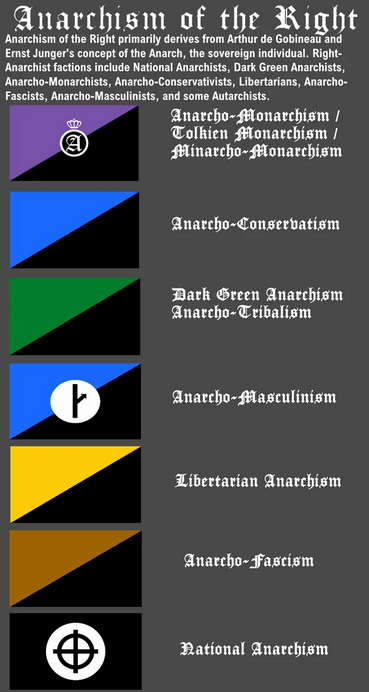
Other types of anarchists and anarchist adjacents from the right (such as free-market libertarians and small government conservatives) have been involved with such causes as limited government, free markets and capitalism, individual freedom and personal responsibility, traditional family values, second amendment rights, national defense and military strength, law and order, lower taxes and reduced government spending, energy independence and domestic production, sovereignty and national borders, school choice and education vouchers, parental rights and family autonomy, pro-life and anti-abortion, religious freedom and expression, right to work and anti-union, fiscal responsibility and balanced budgets, limited regulation and deregulation, support for law enforcement and the military, opposition to political correctness and cancel culture, patriotism and american exceptionalism, support for small businesses and entrepreneurship, pro-growth economic policies and job creation, traditional marriage and opposition to same-sex marriage, opposition to affirmative action and identity politics, support for the coal and oil industries, strong border security and immigration restriction, limited foreign aid and international intervention, support for traditional education and academic rigor, opposition to government-run healthcare, pro-gun and pro-Second Amendment.

Twin Oaks Community (1967-present) An income-sharing, egalitarian, and non-violent commune in Virginia with around 100 members.
Anarchists truly practice the principle of “infinite diversity in infinite combination.” The causes, movements, and issues with which different types of anarchists align themselves reflect the vast diversity of thought and opinion among anarchists concerning what an ideal stateless society organized on such principles as decentralization, local self-rule, free association, voluntary cooperation, autonomous communities, organic culture, and individual sovereignty would look like.
 Anarchist Catalonia (1936-1939) A region in Spain controlled by anarchist and socialist militias during the Spanish Civil War, with collectivized industries and agriculture managed by workers’ councils.
The range of anarchist thought is paradoxical. Paradoxical thought refers to ideas, statements, or concepts that appear contradictory or counterintuitive but, upon closer examination, may reveal deeper truths. Paradoxical thinking can be found in various philosophical traditions, including Buddhism, Taoism, Stoicism, and Existentialism. All of these traditions have influenced anarchist thought.

Shinmin Autonomous Region (1929-1931) An anarchist zone in Manchuria, China, established by Korean independence activists and Chinese anarchists, focusing on mutual aid and self-sufficiency.
In Buddhism, paradoxical thinking is exemplified by the concept of “the middle way,” which is a path between indulgence and asceticism. The Buddha taught that one must avoid the extremes of sensual pleasure and self-mortification to achieve enlightenment. This concept emphasizes the idea that moderation and balance are essential for a fulfilling life.
 Kronstadt Commune (1921) A short-lived, self-governing commune of sailors, soldiers, and civilians in the naval base of Kronstadt, advocating for soviet democracy and freedom from Bolshevik control.
In Taoism, the concept of “wu-wei,” or “non-doing,” is a paradoxical idea that emphasizes the importance of effortless action. This means that by not striving for a particular outcome, one can achieve greater success and fulfillment. The Taoist philosopher Lao Tzu expressed this idea in the statement, “The way to do is to be.”

Freetown Christiania (1971-present) A self-proclaimed autonomous neighborhood in Copenhagen, Denmark, based on anarchist principles of communal ownership and self-governance.
In Stoicism, paradoxical thinking is embodied in the concept of “amor fati,” or the love of fate. This idea suggests that one should accept and embrace one’s circumstances, even if they are difficult or unpleasant. By doing so, one can cultivate inner strength and resilience.

Zapatista Autonomous Municipalities (1994-present) Autonomous regions in Chiapas, Mexico, established by the Zapatista Army of National Liberation, practicing direct democracy and indigenous self-determination.
In Existentialism, paradoxical thinking is expressed in the concept of “authenticity,” which emphasizes the importance of individual freedom and choice. However, this freedom comes with the responsibility of creating one’s own meaning in life, even in the face of an inherently meaningless and chaotic world.

Exarchia (1973-present) A neighborhood in Athens, Greece, known for its strong anarchist presence, self-managed social centers, and resistance to state authority.
Paradoxical thinking is a way of challenging conventional wisdom and assumptions to reveal deeper truths. It emphasizes the importance of balance, acceptance, and individual responsibility, and can be found in various philosophical traditions throughout history.

“In a flat world, you can have left and right, but in a round world, which is what we live on, there are totalitarians at the top (Stalin, Hitler, Genghis Khan) and anti-authoritarians at the bottom (anarchists, communalists, libertarians), with squishy liberals and mindless conservatives in between.”-Kirkpatrick Sale
The era of globalization brought with it an ongoing transition from a “modern” phenomenon of imperialism, centered around individual nation-states, to an emergent postmodern construct created among ruling powers. This new imperialism existed not in the form of multiple empires ruled by nation-states, but in the form of a singular, global Empire ruled by the international super-class. The rise of the Empire signified the decline of national conflict. The “enemy” of the Empire, whoever he was, could no longer be regarded as specifically ideological or national. The enemy came to be understood as a kind of criminal, as someone who represented a threat not to a political system or a nation but to the law. This enemy of the Empire was not regarded not as a rival state or ideological foe but as a “terrorist.” In this new order that enveloped the entire space of civilization, where conflict between nations had been made irrelevant, the “enemy” was simultaneously banalized (reduced to an object of routine police repression) and absolutized (as the Enemy, an absolute threat to the ethical order).
 Rojava (2012-present) An autonomous region in northern Syria with a decentralized government based on direct democracy, gender equality, and communal economy.
By using analogies to classical political theory, the Empire could be understood as consisting of a monarchy (the G20, and international organizations such as NATO, the International Monetary Fund or the World Trade Organization), an oligarchy (the multinational corporations and other nation-states) and a democracy (the various non-government organizations and the United Nations). The Empire was total and resistance could only take the form of negation, or the will to resist. The Empire was total, and economic and political oppression continued, even as all heterogeneous cultural identities were wiped out and replaced with a universal mono-cultural one, the socio-economic identity of the poor persists.
However, multiple subsequent developments have signified the decline of the Empire and a return not to the bipolar world of the Cold War but to the multipolar world consisting of rivalries between Great Powers that existed prior to World War One. The declining influence of the United States as a unipolar hegemon and the assertiveness of the European Union, Russia, China, India, Turkey, Iran, Saudi Arabia, the “Pink Tide” nations, and other international forces have created the foundation for a return to multipolarity.

Most anarchists reject bigotry or out-group hostility concerning race, gender, ethnicity, nationality, religion, gender, sexual orientation, gender identity, age, ability, culture, lifestyle, or other categories. Some anarchists regard “political correctness” as social progress that is helpful for the purpose of overcoming past forms of out-group hostility. Other anarchists feel that political correctness errors by vilifying entire categories of people on the basis of group identity with derisive labels and regard such actions as counterproductive, divisive, ethically dubious, strategically self-defeating and counter to the libertarian ideals of anarchism. Some anarchists regard political correctness as contrary to the freedoms of speech, association, religion, due process, and academic and scientific inquiry. Other anarchists believe such values are secondary to combating social inequality. Some anarchists regard violence against rival political groups as a legitimate preemptive means of preventing future forms of oppression from emerging. Other anarchists regard such actions as inherently authoritarian and creating the foundation for future forms of oppression. Questions concerning the legitimacy of the use of violence and the degree to which to extend tolerance to political enemies have long been contentious topics of debate among anarchists. The late, great anarchist historian Paul Avrich recognized these tensions within anarchism.
Avrich does not shy away from controversy in his books, treating the anarchist acts of violence honestly and in the context of the time. He does not condone the violence of Berkman, but says he still admires his decision, considering how brutal Frick acted toward striking workers. But Avrich does not have the same patience for some contemporary anarchists, who choose to destroy property and who, he says, come mainly from educated and middle-class backgrounds. “I’m not so crazy about anarchists these days,” he says. Anarchism means that you leave other people alone and you don’t force people to do anything.”
He says he is sad that the old-timers are not around to guide the resurgent movement. “They were nicer people –much nicer people.” Their deaths have taken a toll on him. “It’s been terrible for me,” he says. “They were the people who meant the most to me. I admired them and wanted them around the most. There’s nothing else that is me.”

Anti-Oppression Policy
“You have your way. I have my way. As for the right way, the correct way, and the only way, it does not exist.”―
A once prominent journalist observed that theoretically speaking, oppressed minorities represent approximately 372% of the general population. Anarchists normally stand in opposition to all forms of bigotry, oppression, social injustice, or out-group scapegoating including but not limited to racism, sexism, homophobia, transphobia, xenophobia, classism, ageism, anti-Semitism, anti-indigeneity, ableism, looksism, fatphobia, thinism, beautyism, producerism, appearance discrimination, mentalism, sanism, speciesism, adultcentrism, chronocentrism, slut shaming, heterosexism, cissexism, religious oppression, right-handedism, culturalism, anti-transracialism, anti-transablism, anti-otherkinism, environmentalism racism, climate oppression, environmental homophobia, anti-homo sapien-presenting otherkinism, pedophobia,zoophobia, anti-asexualism, anti-sex workerism, therapeutism, monogamism, anti-illegalism, addiction oppression, drugophobia, literatism, educationism, intellectual supremacism, competencyism, alcoholism bigotry, anti-prisonerism, anti-gamerism, parentism, gangophobia, anti-bikerism, anti-aspieism, dylexiophobia, agoraphobia, hydrophobia, penis sizism, four eyes phobia, anti-autism, anti-farsightedism, and cleanism, mansplaining, manspreading, manshaming, anti-unhousedism, white shaming, privilege shaming, redneckophobia, Yankee discrimination, incestophobia, misandry, and cisphobia, Islamophobia, Iranophobia, Russophobia, Sinophobia, Europhobia, medical heretic persecution, historical revisionist oppression, scientific dissident discrimination, cisphobia, Christophobia, rightwingophobia, leftwingophobia, anti-TERFism, anti-SWERFism, conspiracyphobia, anti-carnivorism, anti-omnivorism, anti-vegan, vegetarian oppression, vegetable oppression, pregophobia, historophobia, squirterphobia, medophobia, anti-bipolarism, goldenphobia, analphobia, anti-schizoidalism, statuephobia, anti-strawism, anti-gunownerism, anti-smokerism, cultophobia, occultophobia, TDS, anti-TDS, anti-BDS, anti-BDSM, anti-Renaissance Festivalism, anti-footballerism, and UFOphobia.


On the Social Questions
“Infinite diversity in infinite combinations.” -Gene Roddenberry
On social and cultural questions, many anarchists are cultural liberals or radicals, while some others are cultural conservatives, traditionalists, or centrists. The political philosophies of anarchism transcend ordinary cultural differences of this type. Anarchists, anti-statists, decentralists, libertarians, communalists, utopians, counterculturalists, and other anti-authoritarian radicals differ among themselves on a wide range of questions. These include animal rights, children’s rights, abortion, capital punishment, religion, environmentalism in its many forms, the legitimacy of conspiracy analysis, competing economic views, sexual norms, the role of technology, varying expressions of identity politics, matters of political strategy and many other things. Additionally, anarchists face the challenge of engaging with the wider society outside of the various anarchist and libertarian milieus for the purpose of building a much larger anti-state, anti-ruling class movements for which anarchists provide the leadership and militant wing. This inevitably involves recruiting, organizing, or engaging in dialogue with people from all layers of society and a wide range of cultural backgrounds.

Plato’s Republic (c. 380 BCE) Plato’s vision of an ideal society ruled by philosopher-kings, with a class structure emphasizing justice and the common good.
A core anarchist principle is freedom of association. The state seeks to maintain control over its captive populations through the disruption of organic patterns of human association, migration, and self-determination. The result is a “divide and conquer” effect whereby population groups with conflicting cultural values are needlessly pitted against one another as pawns in the machinations of the political class. Many anarchists have long recognized that the necessary corollary to freedom of association is freedom of disassociation. Autonomous individuals and communities would naturally be free to voluntarily associate or not associate with whomever they choose. It can be expected that an anarchist civilization or collection of polities will include the entire spectrum of predictable human sentiments, values, aversions, and affections.
 Thomas More’s Utopia (1516) A fictional island society with communal property, welfare, religious tolerance, and an emphasis on education and rational thought.
Consequently, there would likely be both religious and secular communities, ecumenical and traditionalist ecclesiastical bodies, sexually conservative and sexually libertarian communities, traditional families in their various forms, feminist or homosexual pairs and pan-sexual relationships, ethnically heterogeneous and homogeneous communities, ethnic communities holding both preservationist and assimilationist norms, communities of carnivores and vegans or vegetarians, primitivist communities or seasteads and space colonies, proprietarian and communistic communities, drug-using and non-drug-using communities, communities with an open-entry stance and communities which prefer restricted entry. The result would be a vast array of tribes and communities reflecting the true diversity of humanity.

 B.F. Skinner’s Walden Two (1948) A behaviorist utopia with human behavior shaped by positive reinforcement, leading to a peaceful, efficient society with shared labor and communal child-rearing.
====================================================================================================================================
Anarchism and the Lumpenproletariat
“Alongside ruined roués with questionable means of support and of dubious origin, degenerate and adventurous scions of the bourgeoisie, there were vagabonds, discharged soldiers, discharged convicts, runaway galley slaves, swindlers, charlatans, lazzaroni, pickpockets, tricksters, gamblers, procurers, brothel keepers, porters, literati, organ grinders, rag-pickers, knife-grinders, tinkers, beggars; in short, the entirely undefined, disintegrating mass, thrown hither and yon, which the French call la bohème.” -Karl Marx
The classical anarchist theorist Mikhail Bakunin recognized a revolutionary potential in many lumpenproletarian groups. Unlike most other political factions, anarchists have often been sympathetic and engaged in outreach to lumpenproletarian subcultures. The lumpenproletarian question is one of the areas of anarchist practice where anarchists have genuinely placed themselves outside the realm of polite society and respectable opinion, including that of the Left. Leftists and liberals have championed the impoverished or exploited, and opposed the persecution and oppression of traditional outgroups such as racial or religious minorities, women, and sexual minorities by the forces of the state and capital or by private or extra-legal violence. However, a substantial number of population groups continue to be recipients of statist assaults while so-called “progressive” political forces look away or even express approval.
Many anarchists seek to stand with all enemies and victims of the state regardless of their social or legal standing. These include all political dissidents subject to repression irrespective of their ideology, and all residents of the total institutions maintained by the state (jails, prisons, detention centers, psychiatric institutions, juvenile facilities, institutions of compulsory education, or conscript armies). Just as past generations have formed civil rights organizations for the defense of racial minorities, feminist organizations for the defense of women, or gay rights organizations for the defense of sexual minorities, some anarchists favor the formation of similar organizations for the defense of the handicapped, those labeled mentally ill, those subject to involuntary civil commitment, students, youth, sex workers, prisoners, the criminally accused, the homeless, anti-police activists, advocates of alternative medicine, drug users, the families of prisoners, migrant workers, lumpen economic elements (jitney cab drivers, peddlers, street vendors, midwives), gang members, outlaw subcultures, and those subject to persecution under laws criminalizing consensual behaviors and the byzantine machinations of the regulatory, managerial state.

On the Question of “Utopianism”


H.G. Wells’s A Modern Utopia (1905) A world state governed by a voluntary elite called the Samurai, focusing on individual freedoms, social responsibility, and progress.
On the Indigenous Question
“I do not think the measure of a civilization is how tall its buildings of concrete are, but rather how well its people have learned to relate to their environment and fellow man.” – Sun Bear, Chippewa
The term “indigenous” is commonly used to refer to those peoples that are either native to a particular geographical region, who existed in tribal forms prior to the rise of nation-state entities, or who share a unique cultural heritage derived from their particular history. These include the native peoples or traditional ethnicities of all nations, regions, or continents. A massive plethora of such population groups exist, including the American Indians/Native Americans of North America, the Indian peoples of Central and South America, the immensely varied ethnic groups of Asia and Africa, and the historic ethnic groups of northern Europe and the Mediterranean. Anarchists frequently support self-determination for all those possessing a unique cultural heritage within a larger state or imperial systems, such as the Basques, Catalans, Scots, Kurds, Romani, Hawaiians, African-Americans, and the aboriginal people of Australia, Tibetans, and Palestinians. Anarchists normally reject racism, ethnocentrism, chauvinism, supremacism, exploitation, or xenophobia toward such ends. Rather, the principles of self-determination imply an ethos of mutual respect and inter-cultural civility.


The Rejection of Imperialism
“Let a thousand flowers bloom.”-Mao Tse-tung (paraphrased)
The anarchist vision of decentralized societies, autonomous regions and localities, self-managed municipalities and villages, stateless tribes and voluntary associations, peoples’ militias, and federated communities offers a vision for future civilizations liberated from the yoke of imperialism, accommodation of the divergent forces that must be mobilized for imperialism’s defeat, and recognition of the ongoing diversification of modern societies.


William Morris’s News from Nowhere (1890) A future England transformed by socialism, with communal ownership, the beauty of labor, and no money or coercive institutions.
On the Economic Questions
“Not until a majority finds the moral courage and the internal fortitude to reject the something-for-nothing con game and replace it by voluntary associations, voluntary communes, or local rule and decentralized societies, will the killing and the plunder cease.” -Antony C. Sutton
Anarchists maintain a preference for economics that are reflective of the anarchist principles of voluntarism, free association, mutual aid, decentralism, pluralism, federalism, and non-hierarchical forms of organization. Anarchists seek to develop alternative economic arrangements that reduce, minimize, or eliminate the dependence of individuals and communities on states, corporations, or the impersonal forces of the market. Towards this end, anarchists endorse such economic arrangements as cooperatives, collectives, communes, clubs, village communities, intentional communities, guilds, mutual aid societies, mutual banks, alternative currencies, land trusts, workers councils, individual and family enterprises, libertarian municipalities, anarcho-syndicalist labor federations, worker-owned industries, stakeholder democracy, participatory economics, tenant associations, professional associations, the gift economy, dual power, decentralized planning, social credit, and squatting.

=========================================================================

Etienne Cabet’s Icarian Communities (1840) A society based on communal ownership, equality, and democratic governance, as described in Cabet’s novel “Voyage en Icarie.”
Vision and Wisdom
from A New Kind of Mind
A decent while back, the anarchism subreddit was getting me down with it’s lynch mobs and sectarianism. To find some sanity (and probably to confirm a couple biases), I asked fellow Reddit user BondsOfEarthAndFire — who describes himself as “a market-friendly, primitivist-friendly anarcho-communist” and is a member I’ve always found to be considerate and wise — for his take on the situation. He did not disappoint:
I think that the notion that all of humanity will ever be operating under the same ‘flag’, so to speak, is astonishingly stupid, and demonstrates a complete lack of understanding of humanity and and dumbfounding ignorance of history. It frankly astounds me that the intelligent folk on this reddit manage to convince themselves that the future Earth will be entirely syndicalist or entirely transhumanist or entirely mutualist, or entirely re-wilded, or entirely fill-in-the-blank.
I’ve described myself as an Anarcho-ecumenist, but I fly the red star because the ancom belief system is closest to the system I would personally like to live in. That system may be made of a hundred people or a hundred million people; I have no way of predicting the future, and neither does anyone else. I do make some very broad predictions, however:
I think that the future will be a world of dizzying social complexity, replete with small city-states with governments ranging the gamut from democratic to monarchical to theocratic, surrounded by vast hinterlands filled with eco-villages and wild ranges where hunter gatherer humans chase wild game and forage for nuts and berries, while vast trade fleets of ultra-light zepellins transfer goods and services all over the planet, and transhumant consciousnesses zip through endless, decentralized computer networks maintained by industrial syndicates a million workers strong, who build satellites and launch them into orbit to maintain a global network of communication so primitivists can use cell-phones to trade furs for plastic-composite bows… and so on. Personally, I wish I was there right now.
In the immediate moment, I’m willing to ally myself with anyone who who believes that humans are capable of developing large-scale systems that can be entirely consensus based. I don’t think these social technologies exist yet, and so I’m working towards trying to figure them out. The answers lie across a dozen different flavors of anarchism, and the only to even begin is to respecting A) each others opinions, B) our differences and similarities, and C) the fact that we don’t have the answers yet – if we did, we’d already be doing it!
It always struck me as incredibly stupid to say, “We agree on 97% of everything, but we have differing notions of what the word trade means, so you are therefore my bitter enemy.” It’s a crock of shit, but it’s worse than stupid: it’s counterproductive. We’re working towards a very different world than the one we live in, and we need 100% of the people involved to be, ya know, actually working towards it. Even if someone thinks your direction is 15 degrees removed from their compass bearing, you’re both still pretty much headed in the same direction.
I’d like to think that my unabashed outreach to the pacifists, Christians, primitivists, transhumanists, mutualists, ancaps, and everyone else is beginning to pick up speed, but there’s only so far the mass mentality can be pushed without a profound, systemic change in the way people perceive their potential allies.
Granted, there’s a lot of room for improvement in relations between the different flags, but on the other hand, compared to what we agree on, it’s actually not that much.
Just beautiful.



Recent Comments