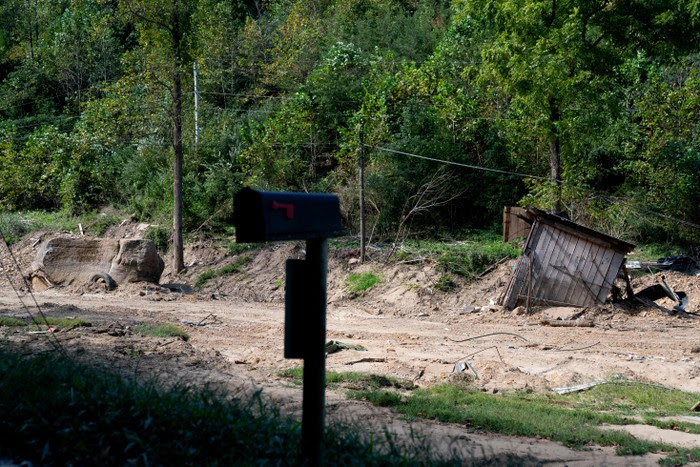
| (Stefani Reynolds / AFP via Getty) |
View in browser
To understand how a freak summer rainstorm could kill 44 Appalachian residents and leave thousands more displaced across eastern Kentucky, you could consider the moment in the early morning hours of July 28, 2022, when the floodwaters that swelled from local creeks darkened from muddy brown to charcoal gray, rising high enough to loosen mobile homes, trucks, and trees from their perches and hurl them through the valleys like missiles. You could recall how the weight of the rain forced families to seek shelter in the hills and watch as their communities washed away down the hollows.
Or you could read an Atlantic article from April 1962. Written by a Kentucky lawyer named Harry Caudill, “The Rape of the Appalachians” was a broadside against a relatively new method of coal extraction—strip mining—and it managed to predict precisely the environmental catastrophe that befell eastern Kentucky this past summer.
“By a process which produces huge and immediate profits for a few industrialists, the southern Appalachians are literally being ripped to shreds,” Caudill wrote. “Eventually every taxpayer from Maine to Hawaii will have to pay the cost of flood control and soil reclamation.”
Traditional mines had been dug downward in the search for coal deposits, then outward along their seams, allowing a team of miners to descend into mountains, chip away at the fuel, and cart it up to the surface. Strip-mining operations, by contrast, deploy bulldozers to clear timber from a ridge’s surface in horizontal streaks, then blast into the mountain’s side with explosives, exposing a seam to the open air. This allows for more efficient extraction of coal but eliminates the forests that help drain and slow runoff from rainstorms. So when the thunderstorms began in late July 2022, water rushed down the mountains unabated, destroying a Breathitt County community called Lost Creek, a small collection of homes gathered down the mountain from a strip mine.
Ned Pillersdorf, a lawyer in Prestonsburg, Kentucky, put it in simpler terms. “If you pour a gallon of milk on a table, it will run off all at once,” he told me. “If you put some towels down, it drips off.” By blasting away soil and timber, strip mining has the effect of ripping towels from the table. As a result, strip mines, he explained, are “time bombs.” When the storms came, water flooded the screened porch where Pillersdorf watches baseball, but he and his family were otherwise unaffected. In Lost Creek, though, nearly every single home was destroyed, Pillersdorf said. Two residents died. “On July 28,” he continued, “one of the time bombs went off.”
Today, Pillersdorf is leading a class-action lawsuit on behalf of many of the residents of Lost Creek against Blackhawk Mining, the company that operates the strip mine, and a subsidiary of Blackhawk, Pine Branch Mining. In an argument not unlike Caudill’s, he alleges that the company’s failure to “reclaim” the mine, by reforesting the area and maintaining silt ponds to prevent excessive runoff, aggravated the flooding. (In a response to his legal complaint, lawyers for Blackhawk and Pine Branch denied all of Pillersdorf’s allegations; the flood, they claimed, was an act of God.)
“I’m not a person that hates the coal industry or anything like that,” Gregory Chase Hays, one of Pillersdorf’s plaintiffs, told me. Like many people in the area, Hays has benefited from coal extraction at various points throughout his life; his grandfather and stepfather were both employed in the coal industry. But he’s come to question how the industry treats the communities around mines: Not long after midnight on July 28, Hays watched as his neighbor’s home floated through his yard. That night, he and one of his sons carried his mother-in-law to higher ground through waist-deep floodwaters. When they were at last able to return to their home, Hays found a notice from one of the local coal companies announcing that it intended to continue blasting away in the mountains nearby. It was posted on the bottom of their door; their stoop had been swept away.
The July floods displaced thousands of people. Some lived in tents for months. Hays, whose HVAC system was destroyed, had his air-conditioning fixed only this past Wednesday.
A February report from the Ohio River Valley Institute and Appalachian Citizens’ Law Center estimates that it will cost $450 million to $950 million to rebuild the approximately 9,000 homes damaged by flooding. As of early March, FEMA has provided just more than $100 million. In keeping with Caudill’s grim prediction that mining would enrich only a few industrialists, the counties most exposed to the potential hazards of strip mining are also among the most impoverished in the United States: Without significant assistance, many families won’t be able to rebuild.
And as global temperatures continue to rise, storms like those that flooded eastern Kentucky and devastated the community of Lost Creek are likely to become more and more frequent. Across Appalachia, each has the potential to unleash a similar catastrophe.
Related:
|