Church and State, The Persistence of the Importance of the Catholic Church and Its Teachings, the New Pontiff, the Long View, Carl Schmitt, and more


Note: Dedicated to my friend Timothy Herman and his lovely family
There are so many things to love about Switzerland and admire about the Swiss people that it’s difficult to focus on just one thing as you end up feeling that that you are doing the country and its people a disservice. That’s just how rich of a place it is, and I use the word “rich” not in the financial sense, but rather to describe its shared wealth in terms of social and cultural development. One of the many things to admire about the country is how you can get anywhere by train. Every city, town, and village is connected by the Swiss train system. The trains are always on time, always clean and comfortable, and the natural beauty of the country makes any journey much more than just tolerable.
I lived in Switzerland for a year some 20 years ago, and I immediately threw myself into the local cultures and learning about them as much as I could over the course of several dozen weekends. The train system made my task much easier to accomplish, as I was able to head out to all points in this small country with ease and be back in time to do what I was employed to do for the time I was there.


I based myself in the town of Solothurn, the capital of the canton of the same name. Considered Switzerland’s most beautiful baroque town, it sits at the foot of the Jura Alps (not to be confused with the Swiss Alps to the south), and has an incredibly beautiful walled town that sits along the Aare River, wonderfully-preserved due to both the efforts of the local administrations throughout the years, and especially to centuries of official Swiss neutrality. The canton of Solothurn is a Catholic one, which gives it a lot of its specific character in a country where Catholicism competed with various strands of Protestantism, particularly Calvinism.
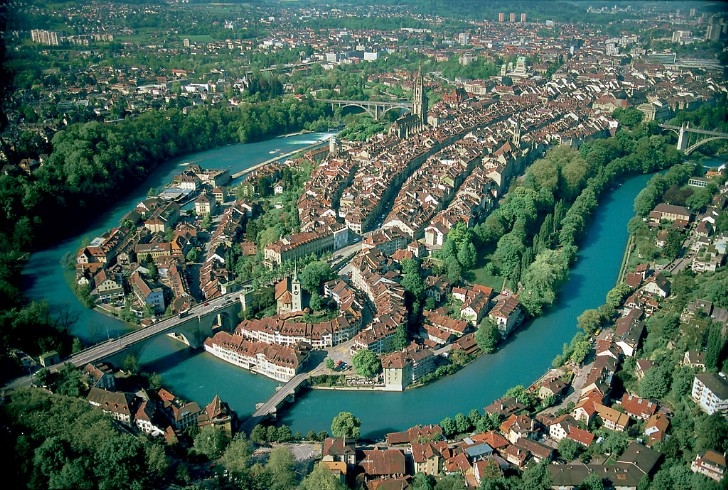
The town of Solothurn is 42 km to the north of the Swiss capital, Bern. Bern’s old town is one of the most beautiful places that I have ever been. Surrounded on three sides by the Aare River (the same one that runs through Solothurn), it is UNESCO-protected and reminds one of a fairy tale. As a person who grew up in North America, seeing well-preserved old buildings and structures such as those found in Bern’s old town never, ever got old. I would routinely jump on a train in Solothurn and make the short trip to Bern on Saturdays at least once a month while I was in Switzerland.
It was the first Saturday in April of 2005 that I decided to take another trip to Bern, but this time I decided that I would do something different this time. Instead of taking the train back, I would leave for Bern earlier than usual and then walk all the way back to Solothurn. The weather forecast promised a “mostly sunny” day with warm temperatures. “Why not?”, I thought to myself. 40 kilometres may seem like a long hike, but in excellent conditions such as those that presented themselves on that spring day, it would be an excellent way to get a better feel for the countryside between the Swiss capital and the little baroque town where I then resided.
40 kilometres is a long way to walk! “It’s worth it, anyway”, I thought to myself somewhere around kilometre 16. I was getting a sense of the lay of the land via foot, something that you cannot get by train voyage. At a certain point beyond the suburbs of Bern, I was able to identify how these towns and villages fed into the Swiss capital logistically and economically in times past, as the spread of the city (and the modern structures that accompanied them) had not yet permeated this far.
Bern is not just the capital of Switzerland, it is also the capital of the canton that shares the same name. Unlike Solothurn, Canton Bern is Protestant. This means that it has certain characteristics in terms of culture and governance that separate it from Switzerland’s Catholic cantons. As the country is very decentralized, these local customs and laws make the country all the more unique….and interesting.
I calculated that I would be back home around 8pm that night, just in time to get ready for a party later that evening that I was invited to. It must have been around 6:30pm when I approached Biberist, a town just inside of Solothurn Canton. Church bells were ringing, and they were ringing for some time. I did not hear any church bells ringing while walking through Canton Bern. The bells did not stop ringing. I was used to church bells ringing at several points through the day in Solothurn, but this time was different as the ringing continued without end. “What’s going on here? It’s not a special Saint’s Day”, I wondered to myself.
It took me a few minutes, but then I realized that this meant that Pope John Paul II had died. The entire world knew that he was not long for this world, and that he could pass at any moment. For me and many like me, he was the only Pontiff that we really knew. I was too young to remember the two who preceded him, so Pope John Paul II was a permanent fixture in my life up until that point, much like Queen Elizabeth II was for many of us up until recently, or like Donald Trump is for us Gen Xers to this day. This was a moment of significance for me, as this would be the first time that I would get to experience what it meant for a new Pope to take the seat at St. Peter’s.


There was so much to think about, and the weight of the significance of the passing of such an important Pope was immense. John Paul II represented a challenge to the Eastern Bloc, and to the communist system that ruled it. The symbolism of electing the first non-Italian Pontiff in centuries was huge. The fact that it was a Pole made that symbolism even bigger, its importance impossible to deny. For those of us Catholics who lived in (or came from) communist countries, this was “our guy”. He was a direct challenge to the monopoly on power held by communists in Central and Eastern Europe, one who threatened not just their rule, but the materialist philosophy underpinning it.
Over the years, many people have asked me to write about faith, particularly my faith as a Catholic. I have always politely demurred from doing this, as I am not exactly the most spiritual of people. In fact, I often jokingly describe myself as “religious, not spiritual”, the inverse of the Eat. Pray. Love. type of female who will claim to be “spiritual, not religious”. There are so many people out there who are better qualified to write or speak on this subject than I am for the simple reason that they have something that I have lacked all these years; a greater sense of, or relation to, the spiritual.
There are many people out there who have received a calling, or who have experienced something spiritually transcendent. I am not one of those people. I do know people like this, and I have encountered actual, serious people who are pious. They are either built different from me, or have experienced something that I have never experienced, or am yet to experience. I am Catholic due to the culture that I was raised in. I am baptized and confirmed. I have received the Sacraments. Just as importantly, at least to myself, Catholicism makes sense to me. This sounds like an attempt at rationalization, and I will accept that criticism. But as I grow older and continue to familiarize myself with Catholic thinking of the past, I keep finding myself in agreement with people like St. Thomas Aquinas or Pope Leo XIII (1810-1903).
I do believe, and this is the most important thing. If you do not believe, you lack faith. If you do not have faith, then you can only look and observe from the outside. When it comes to matters of faith such as these, I do not criticize nor judge. Each person has, or does not have, a relationship with God. Unlike those with a strong spiritual relationship with Him, mine is the result of years of self-reflection of having been a part of the larger Catholic culture that I grew up in. My personal paradox is that my faith is the result of a rationalist conclusion that I have reached about something that is well beyond the rational. Maybe part of this explains why my family has produced so few priests over the years among a people for whom Catholicism is a core pillar of identity? I can count only two priests in my extended family (up to and including third cousins and their children, meaning a sample group of over a thousand individuals).
I am sorry to disappoint those have been hoping for a deeply spiritual reveal of yours truly. The spiritual pond known as Niccolo Soldo is quite shallow despite my beliefs and faith. I do attend Mass, but I should go more frequently. I have a habit of popping into churches when walking by them to say a quick half-Rosary for my family, and sometimes for others. When Norm Macdonald died, I was in Dubrovnik when I found out and I immediately darted into the nearest church in the old town to say several prayers for his soul. Whenever I encounter a Priest or nuns on the street here in Split (and there are many here), I never fail to say “Hvaljen Isus i Marija” (Thanks be to Jesus and Mary) to them, which they will always respond to with good cheer. Maybe this is a superstitious belief that I possess? Could be. I wouldn’t immediately discount the possibility.
I also have a thing where I must walk to church to attend Mass. The idea of driving to church takes something away from it to me. This is easier said than done in places like Croatia where you can’t throw a rock and miss a church. Yet it persists in me. My mind’s ideal for Mass is an entire village walking along dusty roads and up a hill to attend Mass together as one. Unlike my rational argument for faith, this is wholly irrational and entirely aesthetic. Guilty as charged.
“Nic, you’re only Catholic because you were raised in a Catholic culture, one specifically where that identity is very important due to its proximity to non-Catholics”, is a charge that has been directed my way my entire adult life. I have always considered this to be a fair criticism. My response to this charge is that I have gone through moments and periods in my life where I have had doubt, and where I have expressed doubt. Yet I keep returning to the Church and I keep finding myself having faith. This goes beyond mere ‘identity’, despite my admitted lack of spirituality when compared to the pious among us.
My tendency is to keep my faith close to myself and not advertise it. Faith and belief are intensely personal matters which is one reason that I don’t write much about it. What you choose to believe (or not believe) in is your business, and it certainly isn’t any of mine. The reason why I am sharing all of this with you is to put into context my present thoughts on the new Pontiff, Leo XIV.
When Pope Francis passed away, I told people not to ask me for my opinions on who should be the next Pope. I gave them two reasons:
- I don’t know enough about the various Cardinals who could be elevated to the position
- the Church isn’t a democracy, so I consult Priests who I trust on the matter
This is the point where culture, specifically local culture, comes to the fore for me. We Croatians of Bosnia-Herzegovina (I was born just over the border in the town of Livno in West Bosnia) are intensely attached to our Franciscans. The Franciscan Order was sent to Bosnia during the 14th century by the Pope to put out the Bogomil Heresy which was spreading like wildfire throughout Bosnia. Dominicans were unable to reverse the tide, so the Franciscans were sent in when they failed. They have not left since then. Up until the beginning of the 20th century, leaders of the Catholic Church in Bosnia have formed the whole of the elite for Croatian Catholics in Bosnia-Herzegovina. We had no one else. By the middle of the 19th century, Bosnian Serbs had a business elite to go along with their already-powerful Orthodox church. The local Muslims had a large landowning class to work alongside their clerics. We had no one but the Church.
Even this created problems for us, as we were all peasants, and we were suspicious of all Priests who weren’t from the Franciscan Order. To my ancestors and their fellow Catholics in those times, non-Franciscans were suspect, while Franciscans were “of the people, and for the people”. This view persists to this day, and has created conflict from time to time over the years. This cultural artifact is why I place my trust in our local Franciscans, and which is why I don’t write or speak about Church affairs. I leave it to them to do so on my behalf because I trust them. That trust has been earned over the course of centuries of hardship.
For centuries, a major theme in European history was the conflict between Altar and Throne. The Peace of Westphalia (signed in 1648) effectively meant that Throne defeated Altar in Europe, but not comprehensively. For the next two and half centuries, the Church would be fighting a continuous rearguard action as Throne (and later, State) expanded its role in governance and authority at the expense of the Church.
In our present time, the Catholic Church remains an authority, but severely diminished when compared not just to the pre-Westphalian era, but to the time before the Second World War. Scandals such as the industrial-scale abuse of minors in recent decades has served to erode its moral authority, one of the last bastions of its strength. The Church has suffered defeat after defeat, yet somehow it has not completely lost its significance. This is proven by how much media attention is given to the election of the new Pontiff, and how the world of diplomacy has reacted to the selection of Pope Leo XIV to succeed Pope Francis. The Catholic Church is definitely not the same one that chose kings to rule over nations, but it is not a mere international charitable organization, either.
What this means is that the Catholic Church remains important in global affairs despite all the setbacks that it has suffered. For a Catholic like me, this inspires hope and is a cause for celebration. To be Catholic means to be part of a global community united in faith in Christ. In practical terms, it means that I share quite a lot of values and assumptions with over a billion people around the globe. This gives me comfort, as there is strength in numbers. When I met a Catholic person from Africa or Asia or Central America, they will automatically have the same value system built into them that I have, even if either one of us is no longer a believer. The substructure will remain despite any agnosticism, atheism, or defection to another faith. Our base assumptions will pretty much be the same. This creates a connection between the two of us, one on firm grounds. A mutual understanding is established, buttressed by this substructure (this goes for Catholics with the Eastern Orthodox, and vice versa).

Call Me a Schmittian
The persistence of the importance of the Catholic Church, despite all of these setbacks, also means that the State has not completely won its battle against the Altar. It has a rival centre of power when it comes to authority, particularly in the moral sphere.1 From a political philosophical view, this to me is a favourable situation as the state has to compete for loyalty. In my ideal polity, Church and State are not separate, and they act as a check on one another.2 To give either of these two competing centres of power all the power would be irresponsible and reckless, as there would be no effective check on their behaviour. As humans, we are prone to corruption, and we require these checks.
Power is heavily weighed in favour of the State these days, and the State can easily take away the Church’s tax-exempt status at any time in order to bankrupt it. This must be kept in mind at all times when reading about the affairs of the Church when it has to deal with secular matters. This imbalance in power greatly reduces the room it has to maneuver in a modern world that is thoroughly liberal. The Sword of Damocles hangs over its head in which it has a presence.
The Church is also an eternal institution. It goes straight back to the Roman era, all the way to St. Peter, one of Christ’s Apostles. This permanence means that it thinks civilizationally, especially when it comes to politics. It is not hostage to new cycles and should not be hostage to trends. Despite Pope Francis’ emphasis on pastoralism (community outreach), he did not budge one inch on Church teaching when it came to the false issue of “female priests” or “gay marriage”. The Church did what it was supposed to do under his reign; it remained constant in its message and in its values, despite the unfortunate experimentation that coloured his time as Pontiff.
During the early phase of the COVID-19 pandemic, I was flying back to Europe via New York City and while waiting between flights I met a young Catholic Priest from Canada who I later learned had gotten into trouble in the media for simply reiterating basic Church teaching on matters such as “transgenderism”. I broached the subject of Pope Francis with him delicately after winning his trust, and he confirmed my suspicions that many, like him, were not exactly fond of the pastoralist approach that the Pope had launched. He assured me that Pope Francis would not alter millennia-old Church teaching, but he was worried about where pastoralism would lead to.
Every single Pope’s main duty is to be Christ’s Vicar on Earth. That is the heaviest of burdens to shoulder. It means that the Pope (and the Church by extension) cannot be held hostage to ordinary day-to-day politics. He has a larger duty to perform. This is why the shock-outrage media cycle that accompanies anything that the Church does (or doesn’t do) is at best an annoyance. Someone sent me Laura Loomer’s denunciation of Pope Leo XIV in which she calls him a “Marxist”. I do not care what some Der Stürmer caricature has to say about our Pope, nor should any Catholic. The Pope is not supposed to work for #MAGA or for so-called “progressivism”, nor for any other political agenda. The Pope is Christ’s Vicar. Simple as.
POLITICO asks if Pope Leo XIV will “stand up to Trump?”. It is a testament to the continued importance of the Church that everyone, everywhere seeks to get the Pope onside with their political projects. If he and the Church were unimportant and without influence, they would be ignored by politicians and mass media. Even though the Church is built on spiritual matters, it cannot entirely escape the secular realm as this is where it is located.
Indications are that Pope Leo XIV will take a critical approach with populists regarding the hugely important issue of migration. Thankfully, established Church teaching informs us that the preservation of the nation and the ethnos is permitted to Catholics in good standing. We, as Catholics, can in good conscience take a critical view on mass migration without damning our souls.
Based on previous statements, we can expect Pope Leo XIV to continue to reject nonsense such as the “ordination of women”, or the acceptance of homosexual relations in the Church (despite the plague of homosexuals in the priesthood). The Church is not a trend-chaser, thanks be to God.
What is most interesting to me so far is the choice of name for the new Pontiff: Leo. The last Leo was Leo XIII who issued an encyclical in 1891 entitled Rerum novarum, or Rights and Duties of Capital and Labour. This was a very, very important encyclical, as it dealt with the issue of labour at the end of the 19th century, a period in which industrialization was proceeding at a rapid pace in Europe and in North America, and also in which the forces of Marxism were gaining ground as they were becoming seen as the only defenders of the increasingly-miserable working class.
By the end of the 19th century, Europe was rapidly industrializing and people were flocking to the cities to find work in factories where horrible conditions were the norm. Who would represent this new class, this so-called “proletariat”? Anarchists and Marxists quickly leapt at the opportunity to represent, and more importantly, radicalize this quickly-growing constituency. The contemporary aristocracies and gilded classes of Europe and North America ignored them and their demands, effectively ceding them to these radicals, completely oblivious to the danger of alienating large groups in an era of mass politics and the expansion of the vote.
Pope Leo XIII was aware of the danger that this could present in the near future, as the radicals were materialists who sought to undermine and destroy all the pillars of civilization in their quest for power. If the growing working class could not find representation by governing elites, it would turn elsewhere. The Church needed to step in and prevent the radicalization of the proletariat, less disaster ensue. Leo XIII was forward-thinking.
The choice of Leo as the name for Leo XIV carries its own symbolism, as the Vatican News explains:
Turning to the name chosen by the new Pope, Bruni confirmed that the decision to be called Leo XIV was a clear and deliberate reference to Pope Leo XIII, author of the 1891 encyclical Rerum Novarum. That document marked the beginning of the Church’s modern social doctrine.
“In this context,” Bruni said, “it is clearly a reference to the lives of men and women, to their work – even in an age marked by artificial intelligence.”
My interpretation of his name selection is that Leo XIV will make the role of the individual within the state as a core theme of his Papacy, but with the foresight of Leo XIII, meaning that the Church will take an active role to prevent moves towards transhumanism and eugenics, and to steer people away from a misplaced faith in Artificial Intelligence. Christ gave the individual dignity in an era where not all people had it. Leo XIV seems poised to emphasize this basic message.
The reference in the subheader is to famous German jurist Carl Schmitt who wrote at length on church-state relations (.pdf) and whose views on the issue neatly overlap with my own
Only in Catholic and Eastern Orthodox states, naturally